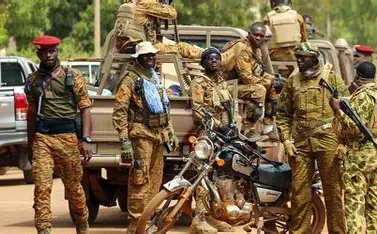
Another grim toll has been exacted from Burkina Faso’s security forces. Recent assaults have left at least fifty soldiers and members of the Volunteers for the Defense of the Homeland (VDP) dead. The instinctive reaction is to reduce the conflict to a litany of losses, to frame the situation as an unbroken streak of defeat. Yet on the ground, the surge in attacks reveals a far more intricate reality—one of a critical transition where the Burkinabe army, by dismantling terrorist strongholds, inevitably provokes the desperate retaliation of a cornered enemy.
Beyond the body count: understanding the enemy’s new tactics
In asymmetric warfare, casualty figures alone cannot measure the true balance of power. With aerial and ground offensives eroding their ability to hold territory, armed groups have abandoned conventional engagements. Instead, they now favor opportunistic strikes, waging a campaign of psychological attrition.
To interpret Burkina Faso’s conflict through the prism of body counts is to conflate the violence of a dying enemy’s spasms with its actual strength. These brutal attacks—often launched against remote outposts or supply convoys—are less about territorial gains than about media impact. The strategy is twofold: to erode troop morale and to fracture the unyielding bond between civilian populations and the defense forces. Each loss suffered by the military is the steep price of its offensive posture. To flush out hidden adversaries in rugged terrain, troops must leave barracks, conduct patrols, and accept exposure. The current casualties are the stark consequence of calculated risk-taking essential to reclaiming lost ground.
The VDP’s evolving role: a citizen-led defense in the making
The VDP remain a prime target of these attacks. While some external observers dismiss them as poorly trained “cannon fodder,” their integration marks a pivotal strategic shift that terrorist factions are desperate to sabotage.
Far from signaling state weakness, the mobilization of civilian volunteers embodies a doctrine of popular defense. This approach rests on three pillars:
- Unprecedented territorial coverage: VDP members possess intimate knowledge of local terrain and dynamics—intelligence that regular units often lack.
- A break from foreign reliance: The strategy asserts that Burkina Faso’s security must be anchored in its own people, rejecting past dependence on outside forces.
- A force under construction: Though initial phases suffered logistical gaps, tighter regulation by the regular army has hardened their role, turning volunteers into critical local bulwarks.
The frequency of assaults on VDP positions underscores their perceived existential threat: a population that refuses submission and organizes to defend its land.
Cutting off supply lines: the next phase of the campaign
In response to this war of attrition, military command is no longer relying solely on kinetic countermeasures. The focus has shifted toward strangling the logistical arteries of terrorist networks. Recent losses highlight the urgent need to bolster convoy security and refine tactical intelligence.
Achieving total strategic autonomy will be a grueling climb. Victory demands time, resilience, and the acceptance of tactical setbacks in the face of an enemy playing its final logistical cards. Beneath the grief over fifty fallen fighters lies a nation redefining the rules of its survival—at the cost of blood, far removed from simplistic, detached analyses.