Over a remarkably short period, Bénin’s healthcare landscape has undergone a profound transformation. Driven by the vision of President Patrice Talon and the Ministry of Health, the sector has been meticulously restructured around four fundamental pillars: robust governance, enhanced infrastructure, advanced technical platforms, and stringent sanitation. The era of frequent and often obscure medical evacuations abroad has concluded, replaced by state-of-the-art referral hospitals, rigorous regulatory oversight, and a commitment to universal health coverage that firmly places the Béninese patient at the heart of national priorities. This is an exploration into a transformation that is genuinely changing lives across the nation.
A bold commitment to renewal
For many years, any discussion of Bénin’s health system inevitably highlighted a series of persistent challenges: deteriorating infrastructure, a critical shortage of cutting-edge equipment, recurring strikes, and a proliferation of illicit medical facilities. Confronting this reality, President Patrice Talon’s administration made a resolute decision from its inception: to abandon temporary fixes and implement a comprehensive, impactful strategy.
Today, the tangible results of this unwavering political will are evident nationwide. Through groundbreaking legislative reforms and substantial investments, Bénin is rapidly emerging as a leading medical hub in the West African sub-region, setting new benchmarks for healthcare delivery.
Governance and regulation: a new era of accountability
The initial cornerstone of this healthcare revolution focused on establishing a new methodology and instilling discipline. To steer this ambitious transformation, the executive body established the Health Sector Regulatory Authority (ARS). This powerful entity meticulously oversees operations, defining standards, ensuring the quality of care, and issuing essential accreditations to all health establishments.
Concurrently, the State implemented a historic and courageous measure: a strict prohibition preventing public sector health professionals from engaging in private practice. This decision, once deemed inconceivable, has been instrumental in restoring the prestige of public hospitals, guaranteeing the consistent presence of doctors at patients’ bedsides.
The drive for sanitation also involved an unrelenting crackdown on clandestine medical practices. Hundreds of illegal clinics and private offices, which posed daily risks to citizens’ lives, have been permanently closed. The message is unequivocal: the health and well-being of Béninese citizens are no longer a secondary concern; they are a matter of national security.
Infrastructure: Bénin builds hospitals for the future
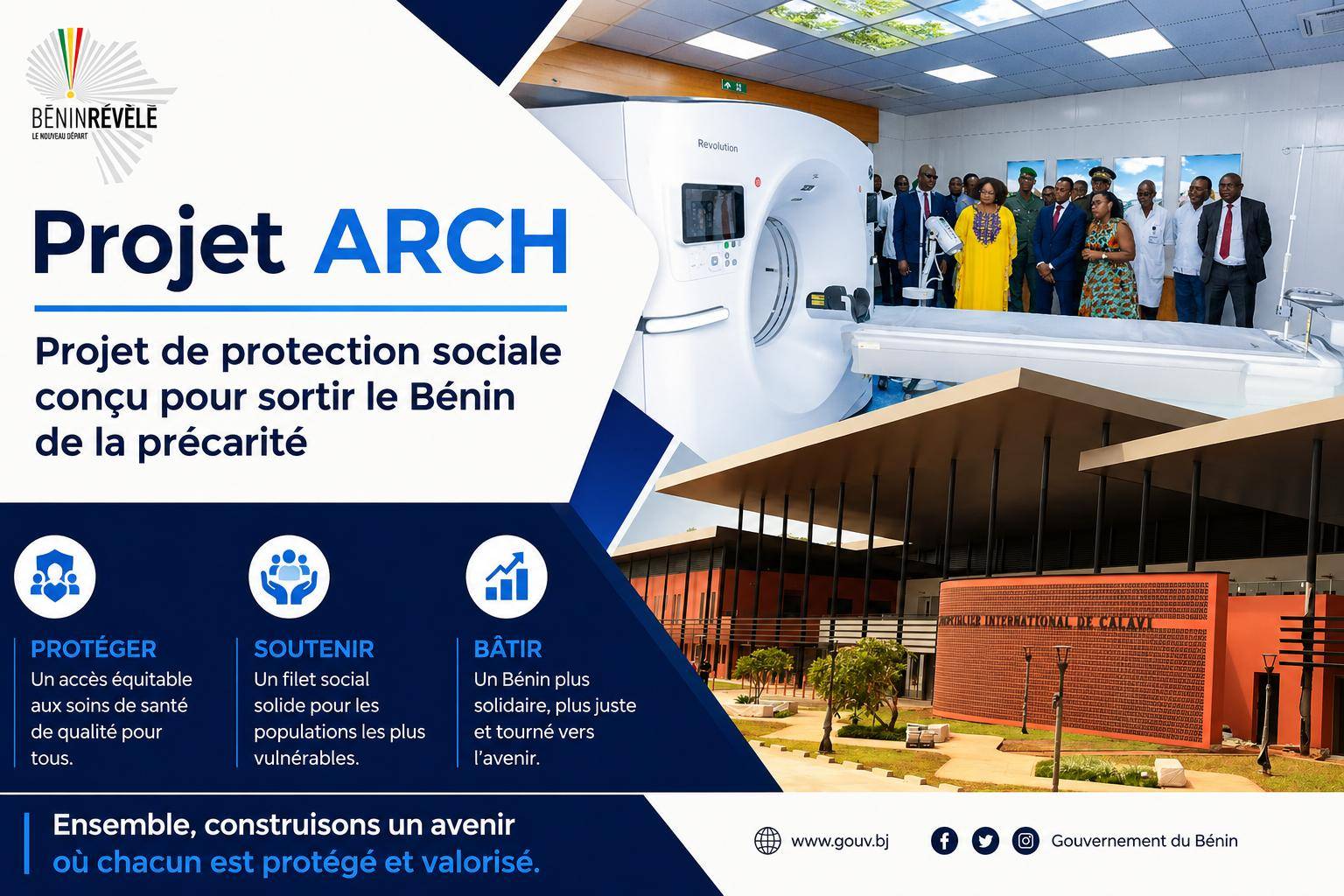
The improvements in infrastructure are immediately apparent. The crown jewel of this dynamic initiative is undoubtedly the International Hospital Center of Calavi (CHIC) in Abomey-Calavi, soon to be complemented by the future Togbin hospital complex. These architectural and medical marvels rival European or Asian standards. Designed to deliver exceptionally high levels of care, they symbolize Bénin’s reasserted health sovereignty.
“With the CHIC, we no longer need to look elsewhere for treatment. Bénin is finally equipping itself with the means to ensure its dignity,” shared a health executive during a recent visit to Cotonou.
However, modernization extends beyond new constructions. Historic institutions are undergoing extensive upgrades. The Hubert Koutoukou Maga National University Hospital Center (CNHU-HKM) in Cotonou, the Mother and Child University Hospital Center of Lagune (CHU-MEL), and several regional hospitals have all been revitalized to bring quality healthcare closer to every household.
Advanced technical platforms and massive investments: the cost of medical excellence
Elevating the technical capabilities was an essential prerequisite to stem the financial and human drain caused by medical evacuations abroad. To realize this ambition, the Béninese State spared no expense, injecting hundreds of billions of FCFA into the sector. This commitment is underscored by the budget allocation of over 198 billion FCFA for health in the finance law, alongside the 275 billion FCFA mobilized for major implementation projects.
A comprehensive and significant upgrade for existing hospitals
To standardize and modernize the CNHU, CHU-MEL, and regional hospitals, President Talon’s administration invested in heavy-duty, high-performance equipment. In the realm of advanced medical imaging, the State acquired multi-slice scanners (up to 64 slices and beyond) for millimeter-precise diagnostics, MRI (Magnetic Resonance Imaging) machines, and latest-generation digital radiology tables.
For operating theaters and intensive care units, rooms have been outfitted with high-performance resuscitation ventilators, multiparametric monitors for real-time vital function tracking, ergonomic operating tables, and laparoscopy equipment for minimally invasive surgery. Furthermore, laboratories and maternity wards have benefited from the automation of medical analysis processes, as well as the provision of modern neonatal incubators and 4D ultrasound machines.
The CHIC: a technological arsenal valued at 115 billion FCFA
At the core of this national strategy stands the International Hospital Center of Calavi (CHIC). The total financing for this healthcare jewel amounts to 175 million euros, approximately 115 billion FCFA, secured through a landmark financial partnership. This substantial investment has enabled the installation of a technical platform that is nothing short of revolutionary for West Africa.
The hospital boasts ultra-modern equipment, starting with a cutting-edge oncology center featuring linear particle accelerators for targeted radiotherapy and biological safety laminar flow hoods for secure chemotherapy preparation. The cardiac and interventional surgery department benefits from a digitized angiography suite dedicated to coronarography and integrated operating theaters equipped with heart-lung machines for extracorporeal circulation during open-heart procedures.
The CHIC’s advanced imaging capabilities also include 3 Tesla MRI equipment, offering exceptional image resolution, as well as fully automated molecular biology platforms capable of processing complex pathologies in record time. Thanks to this formidable arsenal, the diagnosis and treatment of all types of cancers, alongside major cardiovascular interventions, can now be performed in Cotonou and Calavi, sparing families the upheaval and exorbitant costs associated with medical travel abroad.
Health coverage and community care: ensuring no one is left behind
A reform truly achieves its purpose only when it benefits the broadest possible population. This principle underpins the social dimension of the Talon administration’s policy. To operate this revitalized health system, the State embarked on a massive recruitment drive, hiring thousands of health professionals, including doctors, nurses, midwives, and technicians, thereby addressing medical deserts that had long disadvantaged the country’s interior regions.
Central to this inclusive approach is the ARCH project (Assurance for the Reinforcement of Human Capital). Its health component is progressively expanding to all communes, providing free or subsidized health coverage to the most vulnerable populations. Simultaneously, the revival of the National Community Health Policy deploys health relays directly into villages to ensure primary prevention and care.
Finally, 21st-century Bénin is embracing innovation. The digitalization of health services and the gradual adoption of telemedicine platforms now enable a patient in the interior of the country to benefit from the expertise of a specialist based in Cotonou.
A tangible and measurable impact on the population
What is the experience of the average Béninese citizen amidst this monumental shift? On the ground, the impact is reflected in a renewed trust in public hospitals. Waiting times for care have shortened, the availability of essential medicines is more consistently assured thanks to the reorganization of CAME (Central Purchasing Unit for Essential Medicines), and a growing sense of health security prevails.
For the first time, transparency is paramount. The monitoring and evaluation of all these initiatives are rigorously centralized. The publication of the very first national report on the state of the health sector, developed with technical support from the World Health Organization (WHO), attests to this commitment to accountability. This document clearly demonstrates a progressive reduction in maternal and infant mortality, along with improved efficiency in public health expenditures.
The journey forward continues
The progress Bénin has made in just a few years is truly impressive. By simultaneously addressing the structural, material, and ethical shortcomings of the system, the Talon government has laid solid foundations for modern, equitable, and high-performing medicine.
While perfection is an ongoing pursuit, and the maintenance of new high-tech equipment along with continuous staff training remain daily challenges, the trajectory is undeniably positive. Bénin has demonstrated that with political vision, budgetary discipline, and a deep love for the nation, transforming a country’s health system is not a utopian dream, but a tangible reality in motion.