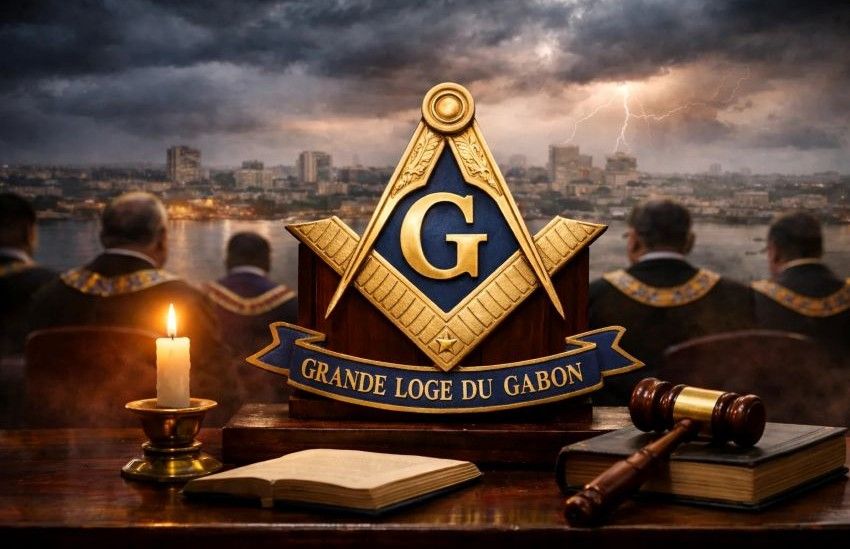
Libreville — For generations, Gabon’s Grand Lodge (GLG) has thrived in the shadows, cultivating an aura of untouchable influence that weathered every political storm. Now, that carefully constructed facade is crumbling.
As the country prepares for a pivotal general assembly, Africa’s most prominent Masonic institution faces an unprecedented internal upheaval. What began as internal disputes over succession has exploded into a full-blown crisis spanning financial irregularities, deep factional divides, and a leadership struggling to maintain cohesion.
The atmosphere within the GLG’s halls has never been more strained. Once celebrated as a bastion of brotherhood and moral elevation, the institution now finds itself entangled in a web of divisions that extend far beyond its symbolic temples.
The collapse of a long-standing order
To grasp the magnitude of this turmoil, we must examine Gabon’s shifting power dynamics. For decades, the presidency and the Grand Master’s role were often held by the same individual, creating an unassailable hierarchy. When President Brice Clotaire Oligui Nguema declined to assume the Grand Master position after taking office in August 2023, he shattered this unspoken tradition.
The move was framed by some as an attempt to depoliticize the institution. For others, it signaled the beginning of a vacuum that would expose long-suppressed rivalries. When Jacques-Denis Tsanga was installed as Grand Master in February 2024, he inherited an organization where authority was no longer centralized under a single, dominant figure.
A succession revealing deep fractures
Three years into his tenure, Jacques-Denis Tsanga’s leadership has become a lightning rod for criticism. Supporters praise his initiatives to restructure provincial lodges, overhaul asset management, and expand the GLG’s international reach. Detractors, however, accuse him of consolidating power, operating opaquely, and mishandling sensitive matters.
Hard numbers tell a troubling story. Regular temple attendance has plummeted from 600 members to fewer than 200. Suspensions, voluntary departures, and expulsions have fueled an unprecedented climate of distrust. The upcoming general assembly looms large, not just as a leadership vote but as a potential turning point for the institution’s survival.
The search for a new gravitational center
This crisis extends beyond Gabon’s Masonic circles, offering a revealing glimpse into the country’s evolving power structures. Historically shielded by its proximity to the presidency, the GLG now confronts the harsh realities of operating independently.
The irony is stark: those who once criticized the blending of political and Masonic authority now witness how that fusion once provided stability. Conversely, the GLG’s newfound autonomy has laid bare fractures that were previously contained by a centralized leadership.
This isn’t merely about electing a new Grand Master. It’s about whether the institution can forge a unified vision in an increasingly fragmented environment. Every organization faces this challenge—when the center of gravity weakens, ambitions turn from collaboration to competition.
The GLG’s current crisis tests its resilience. If it can channel this period of tension into renewal, it may emerge stronger. If not, today’s disputes could cement a lasting fragmentation. For an institution that once wielded secrecy as its greatest strength, the public fractures send a powerful message: even the most entrenched systems must confront the fragility of unity when authority wanes.