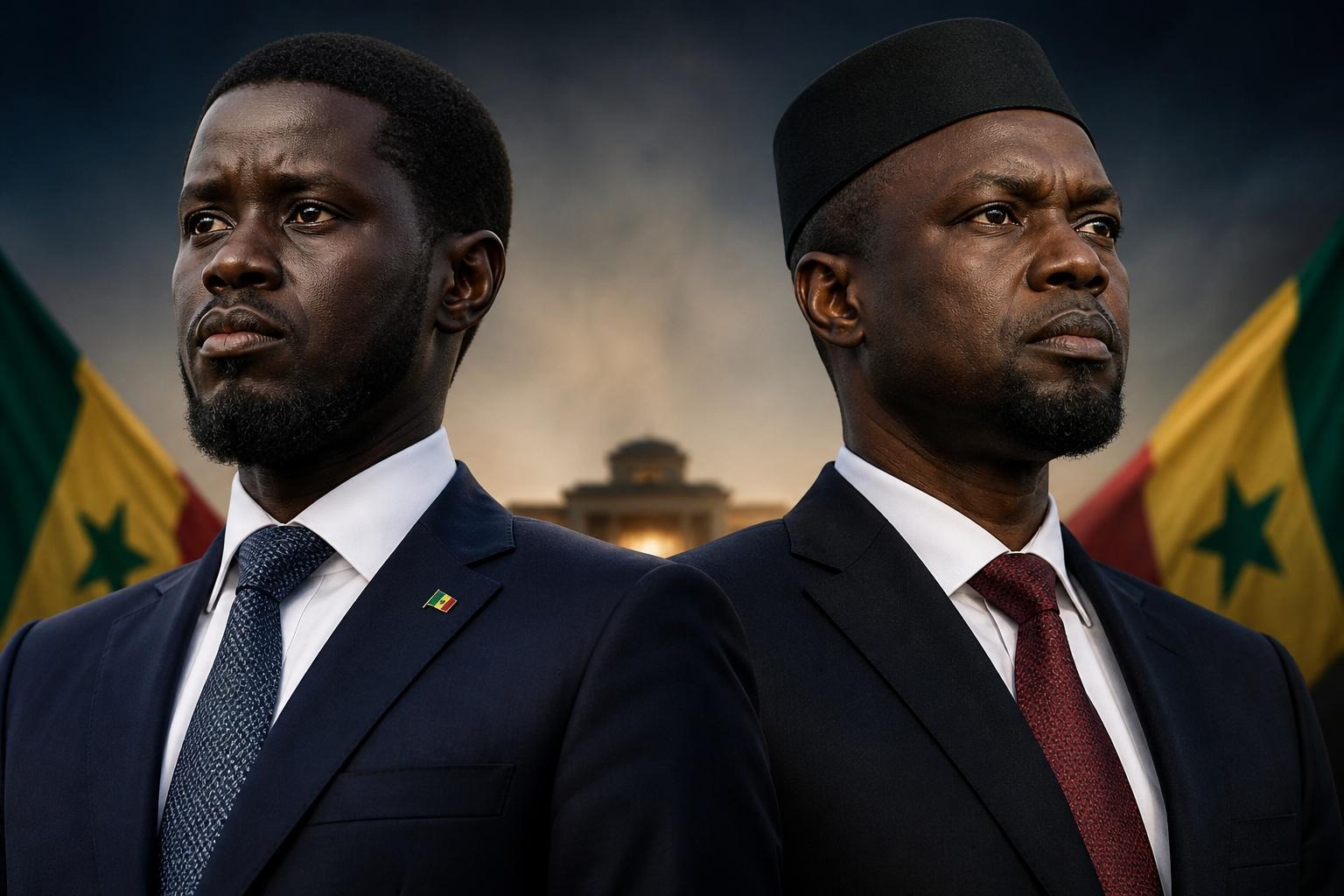
The honeymoon period at the pinnacle of the Senegalese state appears to be giving way to a more abrasive form of realpolitik. The weekend of May 2 and 3, 2026, represented a major symbolic turning point in the professional bond between President Bassirou Diomaye Faye and his Prime Minister, Ousmane Sonko. By publicly addressing his disagreements with Pastef and declaring himself “ready for a separation” if the national interest required it, the Head of State shattered the illusion of an inseparable partnership. Between presidential independence and party loyalty, Sénégal is watching closely as what looks like the start of an unprecedented political realignment unfolds.
A weekend of defining boundaries
A single sentence, shared during a conversation with the national press, set the media landscape ablaze. Until now, the official narrative focused on a unified duo—a pair where the mentor and the protégé moved in lockstep toward promised reforms. However, the tone has shifted significantly.
When questioned about the increasing friction between government policy and the aggressive rhetoric of Pastef leaders, President Faye displayed unexpected resolve. He pointedly reminded the public that he had officially resigned from the party to serve as the president for all citizens of Sénégal. His words struck like a lightning bolt across the political sky of Dakar when he stated that while his commitment to the project was total, his ultimate responsibility was to the people. By clarifying that he would not hesitate to finalize a split if partisan agendas clashed with his vision for the state, he definitively marked his territory.
The shadow of Ousmane Sonko: A dominant Prime Minister
To grasp the depth of this friction, one must look back at the origins of this administration. Elected under the banner that voting for Diomaye was the same as choosing Sonko, the President has long had to manage the overwhelming media presence of his Prime Minister. The charismatic leader of Pastef never truly stepped out of his role as party chief, frequently holding rallies and making direct statements that often bypassed the official communication of the Palace.
For several months, strategic gaps have widened on critical issues. The management of national debt and interactions with international bodies highlight this divide, with the Prime Minister advocating for a radical break while the President favors a more diplomatic and pragmatic path. Similarly, the appointment process has caused internal strife, pitting the President’s desire for technocratic expertise against party pressure to reward long-time activists. Ultimately, the contrast between the fiery nature of Ousmane Sonko and the calm solemnity Bassirou Diomaye Faye seeks to project has become impossible to ignore.
Is a political divorce now unavoidable?
While claiming an immediate separation might be premature, it is now an acknowledged political possibility. The President seems to have realized that to leave a lasting legacy, he must stand on his own. Within the Prime Minister’s circle, there are attempts to downplay these comments as a mere division of labor, but the presidential message hints at a deeper change. By expressing a readiness to break away, the Head of State is signaling to his base that the presidency will not be held hostage by any specific interest group.
This development leaves Sénégal in a period of institutional uncertainty. The nation has seen turbulent executive pairings before, and many now fear a potential paralysis of the state machinery. If a rupture occurs, the President will face the challenge of leading without the full support of the Pastef activist network, forcing him to find new alliances or govern through executive orders.
The challenges of presidential autonomy
The primary goal for Bassirou Diomaye Faye is to maintain the confidence of international partners regarding the country’s stability while proving to the public that he is firmly in control. Public opinion is currently split. A portion of the youth, still captivated by Ousmane Sonko, might view this move toward independence as a betrayal. Conversely, more legally-minded citizens welcome the emergence of a president who is finally embracing the full scope of his sovereign duties.
The President is currently navigating a high-stakes political game. He must assert his power without sparking a major social crisis that political rivals could exploit. The core issue is no longer whether the two men get along, but whether the state’s structure can permanently sustain two competing centers of power.
As observers of the political landscape, we are witnessing the end of a certain idealistic phase. Politics is rarely about brotherhood; it is about the exercise of power. Bassirou Diomaye Faye has reiterated that the Constitution grants him powers he is now determined to use independently. The partnership was the vehicle for winning the election, but it now appears to be an obstacle to governing. Sénégal is entering a mature phase where the state must take precedence over the party, and the President has just drawn the line.