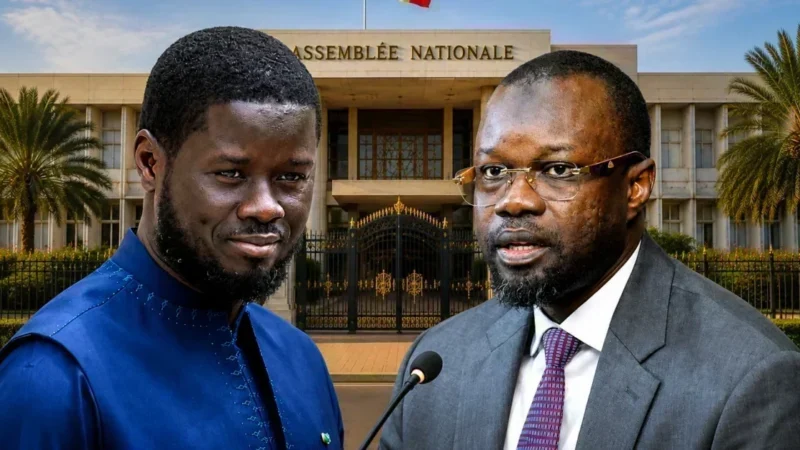
Senegal politics: opposition leader clarifies stance on government
During a heated session in the National Assembly, Deputy Mbaye Dione delivered a politically charged address that transcended economic discussions on IMF policies, debt management, and local government funding. The final segment of his speech shifted focus to the broader political climate, particularly the relationship between the ruling party and opposition forces in Senegal.
The parliamentarian directed a direct message to Ousmane Sonko, conveyed through the Assembly President, underlining the unusual tension characterizing the current political landscape. His words carried a tone of solemnity and purpose, aiming to clarify a fundamental distinction.
Opposition does not mean hostility
One of the most striking declarations of the session came when Mbaye Dione stated, « We are not his enemies. We are his opponents. » This statement was not merely rhetorical; it served as a clear demarcation between political disagreement and personal antagonism. The deputy emphasized that opposing government policies or a ruling majority does not equate to opposing the nation itself or its leaders.
The opposition, he asserted, operates within a republican framework, committed to constructive participation in democratic debate. This includes supporting government initiatives when aligned with national interest while firmly opposing measures deemed detrimental. The parliamentarian underscored the legitimacy of opposition as a pillar of democracy, not a threat to stability.
A lesson from Sonko’s own past
Mbaye Dione drew a parallel with Ousmane Sonko’s political journey, recalling the latter’s history as a prominent opposition figure who frequently utilized institutional platforms to voice dissent. The deputy challenged Sonko to apply the same standards he once advocated: accepting political contradiction as a natural aspect of democratic governance.
In his view, consistency is essential. Those who previously opposed government actions should now respect the right of others to do the same. This call for reciprocal respect aimed to foster a more balanced political discourse, where ideological differences do not escalate into personal or institutional conflicts.
The Assembly as a forum for democracy, not confrontation
Beyond addressing Sonko directly, Mbaye Dione used the opportunity to reflect on the role of the National Assembly itself. He described the institution as a cornerstone of the Republic, responsible for fostering debate, oversight, and accountability. A warning was issued against reducing the Assembly to a battleground for political score-settling.
The deputy stressed that the dignity of the Parliament—and by extension, the quality of Senegal’s democracy—depends on maintaining a constructive environment. His remarks reflected a broader concern: ensuring that legislative sessions remain spaces for reasoned exchange rather than arenas for confrontation.
Opposition as a force for responsible governance
Mbaye Dione positioned the opposition as a responsible and vigilant force, rejecting the notion of obstructionism for its own sake. Instead, he framed their role as one of constructive scrutiny—supporting sound policies while firmly opposing those that undermine national interests.
« We will act as responsible republicans and courageous opponents, » he declared, reinforcing the idea that opposition is not synonymous with disloyalty. It is, rather, an essential mechanism for holding power to account and ensuring policies serve the greater good.A call for political calm
The deputy’s intervention extended beyond institutional critique. It served as an appeal for political calm, urging the ruling authorities to recognize the legitimacy of opposition voices. His message was clear: democracy thrives when governance coexists with dissent, and opposition is not an act of betrayal but a fundamental right.
By affirming that opponents are not enemies, Mbaye Dione sought to reframe political debate in Senegal, shifting it from a climate of confrontation back to one of institutional and republican discourse.