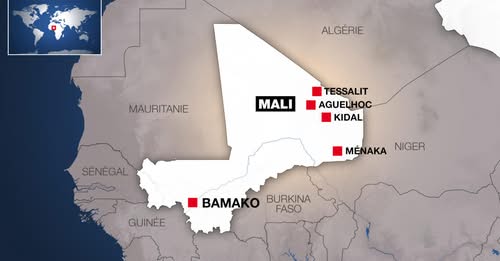
The security landscape in northern Mali has deteriorated rapidly, plunging the region into a state of heightened uncertainty. Within days, the strategic balance has shifted dramatically. Following the symbolic fall of Kidal, armed factions have continued their relentless advance, while the Group for the Support of Islam and Muslims (JNIM) has launched an unprecedented political maneuver by calling for the overthrow of the transitional government.
a military setback reminiscent of past turmoil
History appears to be repeating itself in tragic fashion. On May 1, 2026, fighters from the JNIM and independentist factions of the Azavad Liberation Front (FLA) seized control of key military installations in Tessalit and Aguelhoc. The withdrawal of the Malian Armed Forces (FAMa) and their Russian partners, Africa Corps, enabled the attackers to enter without resistance. A verified image, widely circulated, captures the gravity of the moment: Seidane Ag Hitta, a prominent JNIM leader, proudly displaying the keys to the Tessalit base. This symbolic act underscores a stark reality—five years after the departure of the Barkhane force, the situation remains precarious. Since April 25, towns such as Ber, Tessit, Hombori, and Gourma Rharous have fallen, leaving the populations of Gao and Timbuktu in a state of mounting dread.
Bamako’s counteroffensive and international support
Despite this severe setback, the leadership in Bamako remains resolute. General Assimi Goïta has rallied the nation with a call for a « national awakening, » declaring that no « coercion » will deter Mali from its course. The counterattack is being waged on two critical fronts:
- Air and Ground Operations: The Malian army has intensified precision strikes on Kidal, targeting key administrative buildings and supply depots. While rebel factions dispute casualty reports, officials in Bamako assert that several « terrorists have been neutralized. »
- Logistical Resilience: As jihadist forces tighten their grip by blocking critical roadways into the capital, a convoy of 800 fuel tankers successfully broke through this Friday under heavy military escort, ensuring essential supplies reached Bamako.
From Moscow, the Kremlin, through spokesman Dmitri Peskov, has reaffirmed its unwavering support for the transitional authorities, dismissing concerns of a potential Russian withdrawal following the losses sustained in Kidal.
the JNIM’s strategic shift: blending politics with ideology
The most significant development in this unfolding crisis is the JNIM‘s adoption of a political narrative, marking a stark departure from its usual rhetoric. In a communiqué released late on April 30, the group abandoned its militant discourse in favor of a message tailored to resonate with broader societal factions.
The JNIM now appeals to « the nation’s vital forces, » political parties, and religious leaders to form a « united front » aimed at achieving a « peaceful transition » and ending the « dictatorship of the junta. » By invoking themes of « sovereignty » and « dignity, » the group seeks to sway public opinion, weary of prolonged conflict, while reaffirming its ultimate goal: the establishment of Sharia law.
« In dire straits, one seeks the least harmful option, » remarked a former opposition minister, encapsulating the dilemma now facing Mali‘s political class. Should dialogue with former adversaries be pursued to stem the tide of instability?
internal fractures deepen the crisis
Tensions have seeped into the very institutions meant to uphold stability. The prosecutor of the Bamako Tribunal has announced the arrest of several military personnel, accused of complicity in last weekend’s attacks. As rebel factions extend their territorial control, the JNIM‘s ambiguous political overtures and the economic stranglehold of the blockade push the transitional government into its most profound crisis yet. The struggle for Mali is no longer confined to the desert sands of the north—it now encompasses the battleground of political legitimacy in Bamako.