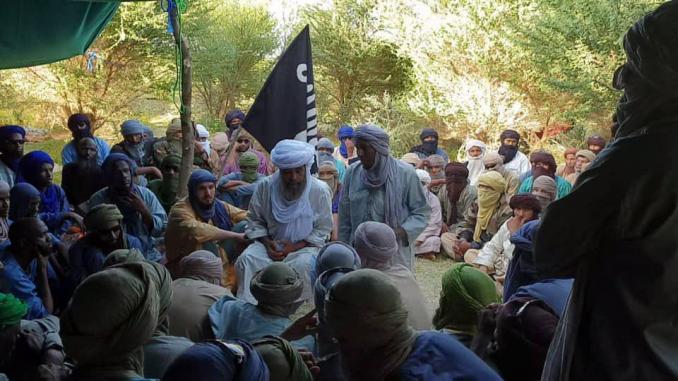
The Group for the Support of Islam and Muslims (JNIM), an Al-Qaeda-affiliated faction, continues to escalate its operations across Mali, despite intensified military campaigns by national forces and international allies. Recent ambushes on army convoys, targeted strikes on military outposts, and systematic pressure on key road networks underscore the group’s growing operational reach in multiple regions.
Regional spillover and deepening instability
The escalation is no longer confined to Mali. Its ripple effects are spreading across the entire Sahel, raising alarm among neighboring African nations. Weak governance structures, compounded by severe economic distress, create fertile ground for the metastasis of Islamist insurgencies. The situation demands urgent regional coordination, yet persistent fragility in state institutions and economic systems continues to undermine collective security efforts.
A strategy built on local infiltration, not just violence
Reports from central Mali paint a concerning picture. On May 21, 2026, five villages in the Bandiagara region were struck in coordinated attacks claimed by the JNIM. While official casualty figures remain undisclosed, the assaults signal a calculated expansion of the group’s influence.
Rather than relying solely on clandestine mobility, the JNIM has methodically embedded itself within local communities. It exploits ethnic tensions, local grievances, and the absence of state services to erect parallel systems of governance. In rural zones, the group imposes its own mediation mechanisms, travel restrictions, and informal taxation regimes—essentially filling the void left by a retreating state.
This strategy exposes the limitations of purely military responses. Even when security operations regain control of an area, the lack of restored administrative, judicial, or economic structures leaves communities vulnerable to re-infiltration by armed groups.
The shifting security landscape in Mali
Since the withdrawal of foreign forces and the deepening partnership with Russian security contractors, Bamako has pursued a policy of military sovereignty. Authorities frame this pivot as a break from Western dependency, yet violence persists, and insurgent groups maintain high operational mobility.
International observers have also documented allegations of human rights abuses involving Malian armed forces and their allied units. While Bamako consistently denies these claims—labeling them foreign smear campaigns—such accusations further erode trust and shrink the space for political mediation.
Geopolitical rivalries fueling the crisis
The Sahel has become a battleground for competing global and regional powers. Russia, Turkey, the United Arab Emirates, Western states, and regional actors all vie for influence, often exacerbating existing divisions among Sahel nations.
In this fractured environment, jihadist factions thrive, exploiting closed borders and weakened regional cooperation. The danger lies in the normalization of chronic insecurity. Entire regions now exist in a precarious balance—neither fully controlled by the state nor exclusively dominated by armed groups. The critical question remains: how far will this instability spread? With the Africa Corps mercenaries beginning to disengage from conflict zones, the future stability of Mali hangs in the balance. What happens if these forces fully withdraw?