Hidden energy leverage in Morocco-spain tensions

Beneath the recurring political and migration disputes between Morocco and Spain lies a less visible but critical vulnerability: energy dependency. While Rabat frequently asserts its territorial claims over Ceuta and Melilla, the kingdom’s energy supply remains heavily reliant on Spanish-controlled infrastructures—a paradox that shapes their bilateral relationship.
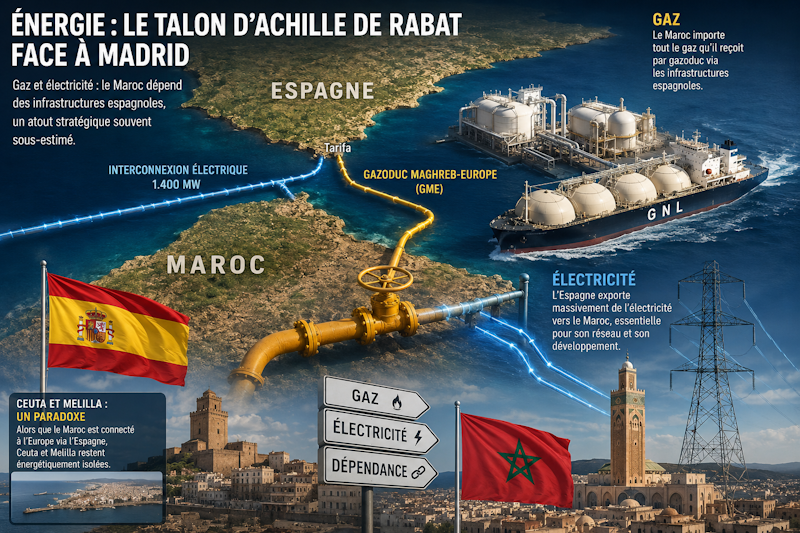
Beyond the headlines of migration crises and diplomatic standoffs, Spain holds strategic leverage through energy networks. Morocco imports all its piped gas from Spanish-operated pipelines and depends on electrical interconnections with the Iberian Peninsula for grid stability and flexibility. This interdependence creates an asymmetrical power dynamic that Rabat is actively seeking to reduce.
Gas pipeline reversal exposes Morocco’s vulnerability
Morocco’s energy dependency deepened after Algeria severed its gas supply in 2021. The rupture of diplomatic ties between Algiers and Rabat forced a complete reversal of the Maghreb-Europe Gas Pipeline (GME), which previously carried Algerian gas to Spain via Morocco.
Today, the pipeline flows in the opposite direction. After Algeria halted supplies through GME, Morocco began receiving gas from Spain—transiting through the very infrastructure that once served its own energy needs. In 2025, this arrangement delivered approximately 10.3 TWh of gas, accounting for about a quarter of Spain’s total gas exports that year and valued at nearly €400 million.
The shift highlights a stark reality: Morocco’s current gas supply is now indirectly dependent on Spanish infrastructure, despite its historical role as a transit country. While Rabat pursues alternative projects, such as the Nador West Med LNG terminal and the ambitious Nigeria-to-Morocco pipeline, these solutions remain years away from full operational capacity.
Electricity trade reveals another layer of dependency
Morocco’s energy ties with Spain extend beyond gas. Two submarine cables link their electrical grids, with a combined capacity of 1,400 MW. In 2025, Spain exported a record 3,743 GWh of electricity to Morocco—an increase of 47.5% year-on-year and the highest level since 2017.
Nearly 75% of this exchange flows from Spain to Morocco, providing critical support to Rabat’s expanding grid. The connection enables Morocco to balance supply during peak demand, integrate renewable energy projects, and maintain industrial growth. Plans for a third submarine cable would further cement this interdependence.
Ceuta and Melilla: an ironic energy divide
The contrast between Morocco’s integration into Europe’s energy grid and Spain’s enclaves in North Africa underscores an unexpected paradox. For decades, Morocco has been interconnected with the European electricity network through Spain, while Ceuta and Melilla operated as energy islands—relying on autonomous systems.
That isolation will end for Ceuta in 2026 with the completion of a €300 million submarine cable linking the city to mainland Spain. Melilla, however, remains geographically cut off from the Spanish grid, perpetuating its reliance on local generation.
Geopolitical leverage in an era of shifting power balances
Energy infrastructure was once viewed solely through an economic lens. Today, in a context of rising tensions in the Mediterranean and North Africa, these networks have acquired geopolitical significance. While Spain holds no apparent intention to weaponize energy flows, the structural vulnerability they create introduces a subtle but potent lever of influence.
Morocco’s traditional advantages—migration control, counterterrorism cooperation, and pressure over Ceuta and Melilla—are well-documented. Yet Spain’s role as the primary gateway for Morocco’s gas imports and the sole electrical interconnection to Europe presents a counterbalance that is often overlooked.
Until Rabat’s alternative energy projects come online, Madrid retains a strategic advantage that could reshape the bilateral equation—especially as territorial disputes and regional competition intensify.