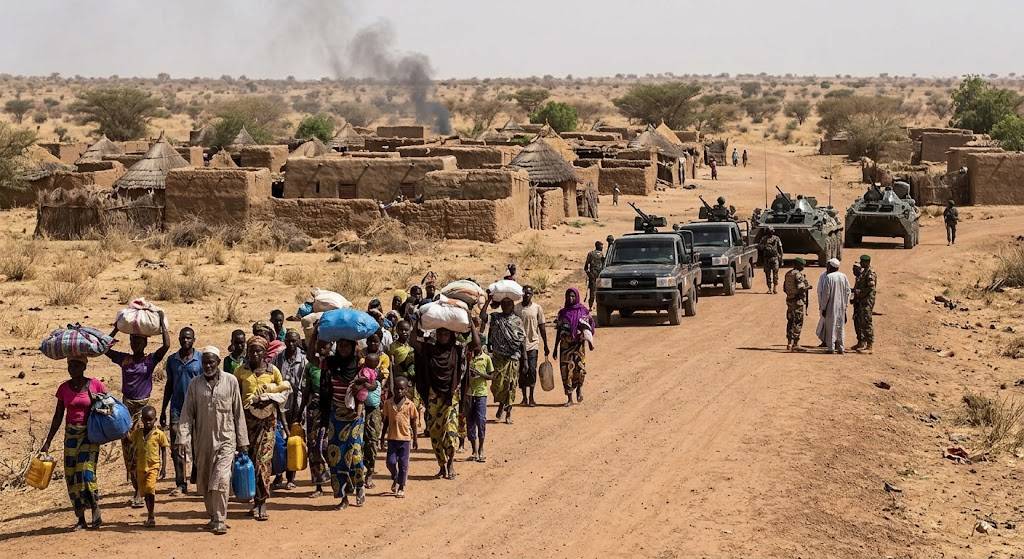
The abrupt announcement of a mass eviction affecting 26 000 individuals in Niamey has sparked widespread outrage among civil society leaders and affected communities. In executing this sweeping operation devoid of proper accommodation measures or resettlement plans, the transitional government under General Abdourahamane Tiani has prioritized coercive action over the fundamental rights of its citizens. The critical question now arises: is this the standard by which governance should be measured?
Maikoul Zodi, a prominent voice in Niger’s civil society, expressed his distress over the unfolding crisis, stating, “Last night, I could not sleep.” His reaction underscores the gravity of a situation that threatens to escalate into a full-blown humanitarian emergency. Displacing an entire population of this magnitude is tantamount to erasing a small city from the map overnight. While authorities often cite urban planning or security imperatives to justify such demolitions, the methods employed in this case border on illegality and disregard for human dignity.
a blatant disregard for legal and international obligations
Governance extends beyond the signing of expulsion decrees in the secluded chambers of the National Council for the Safeguard of the Homeland (CNSP). At its core, governance must be rooted in the protection of citizens. Yet, by thrusting thousands of families into absolute precarity, the current leadership has violated the most basic legal and ethical principles.
As Maikoul Zodi rightly emphasizes, Nigerien statutory law and international covenants—particularly those addressing economic, social, and cultural rights—strictly regulate the process of public land release. Any large-scale clearance operation must adhere to the following requirements:
- A thorough prior assessment of impacts on affected populations;
- A meticulous census of those involved;
- Just compensation and a viable resettlement plan before any action is taken.
Failure to meet these essential conditions transforms this operation into a forced eviction, a practice explicitly prohibited under international law and widely recognized as a severe violation of human rights.
human cost of bureaucratic decisions
The sterile bureaucratic term “eviction” masks the profound human suffering unfolding on the ground. Behind it lie shattered childhoods as students are abruptly uprooted from their schools, vulnerable women left without shelter, elderly individuals abandoned to their fate, and laborers plunged into destitution. In a nation already reeling from successive crises, how can a government justify casting its own citizens into homelessness without a thought for their future? What recourse is offered to these 26 000 souls? None. They are left to navigate an uncertain and bleak tomorrow alone.