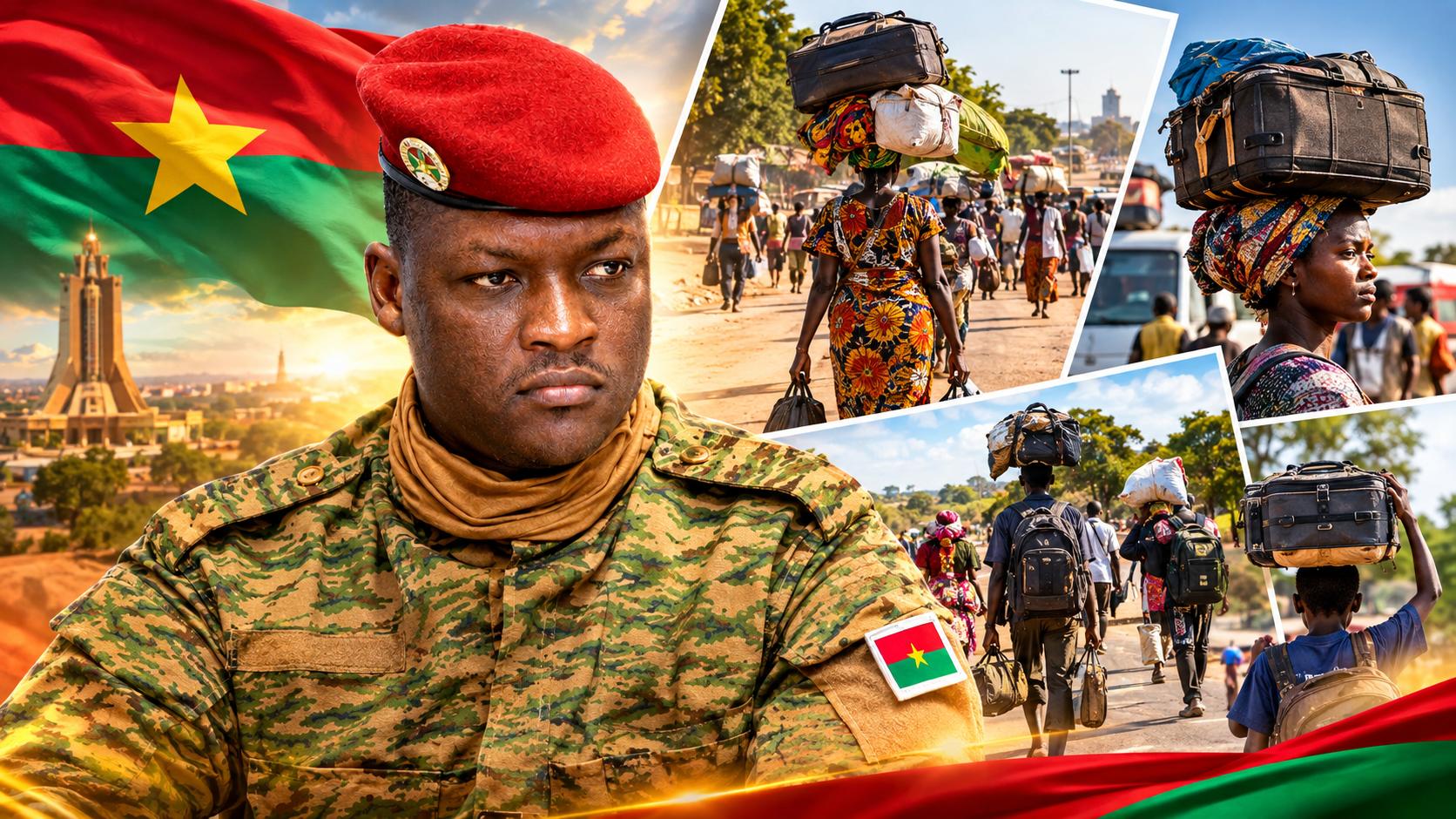
For over two years, Burkina Faso’s leadership has consistently adopted a confrontational stance toward France. Under the leadership of Captain Ibrahim Traoré, Paris has been repeatedly portrayed as the emblem of a colonial past from which Burkina Faso aims to sever all ties. The expulsion of French troops, the denunciation of Western influence, and the public alignment with Russia and Iran have become central themes in the administration’s communication strategy.
Yet, beneath this veneer of defiance, intriguing details have come to light.
An unexpected visa request
Reliable sources within Burkina Faso’s diplomatic circles indicate that Inoussa Traoré, the elder brother of the transitional president, recently submitted a visa application to French authorities in Ouagadougou. The request was reportedly handled with the utmost discretion, reflecting the sensitive nature of the situation.
Inoussa Traoré, who serves as a special advisor to the president, is said to be seeking medical treatment in France. Historically, he has preferred healthcare facilities in the Netherlands for his medical needs. While the French Ministry of Foreign Affairs has not publicly acknowledged this request, it has not dismissed the possibility either.
A striking contradiction
If these reports hold true, they expose a glaring inconsistency in the government’s approach. Since assuming power, Ibrahim Traoré has built his political narrative on an unwavering opposition to France. Official statements frequently denounce Paris, blaming it for various challenges facing the country, and advocate for a definitive break with former colonial powers.
In this context, the visa application from a close relative of the president raises a critical question: Why seek entry into a country that is publicly condemned as a strategic adversary?
This discrepancy provides ammunition for critics who have long accused the regime of hypocrisy, highlighting a disconnect between its political rhetoric and the personal decisions of its leaders.
The limits of sovereignist posturing
The Burkinabè government champions absolute sovereignty and claims to have overcome its reliance on France. However, practical realities—such as medical needs, financial transactions, or administrative requirements—often require engagement with European partners, despite the official discourse.
In the case of the Traoré family, this visa request, if confirmed, could reinforce accusations of a double standard: a tough stance in public while privately relying on France when necessary.
Political credibility at stake
This situation underscores the scrutiny that political actions face, beyond mere words. When a nation publicly brands another as an enemy or undesirable partner, any private interaction with that country risks being seen as a contradiction. While this does not necessarily indicate political inconsistency, it fuels debates about the credibility of Burkina Faso’s sovereignist narrative.
Ultimately, if these reports are accurate, they would demonstrate the challenges of pursuing a policy of outright rupture with France while simultaneously addressing personal or institutional needs that necessitate French cooperation.