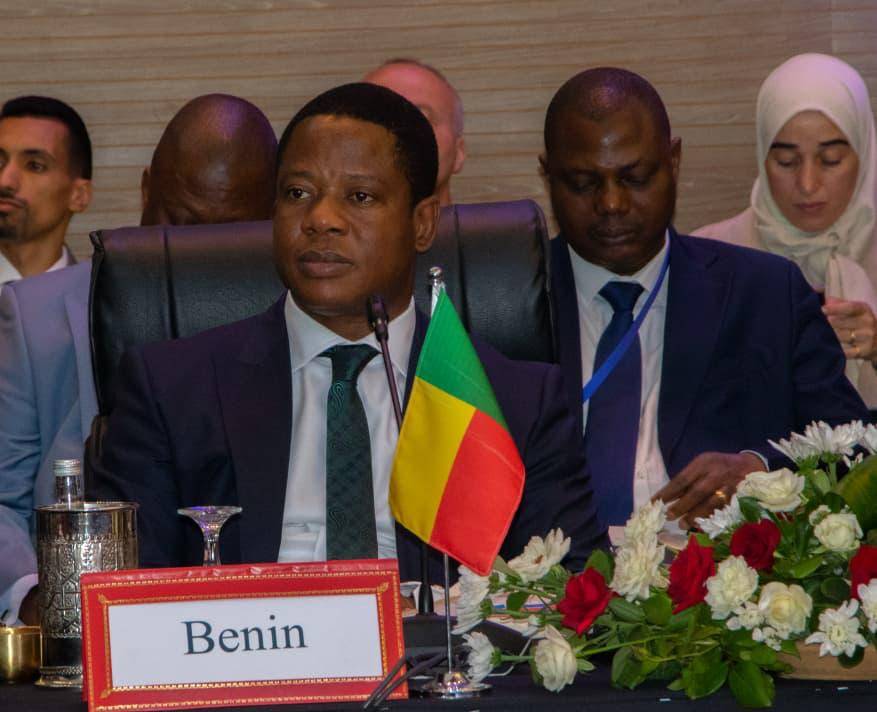
On Tuesday, July 14, 2026, Rabat played host to the 17th CAFRAD Pan-African Ministerial Forum. Leading up to the 61st session of the Board of Directors, Benin’s Minister of Budget and Public Service, Rodrigue Chaou, presented his nation’s ambitious vision. Through a blend of service digitalization and structural reforms, Cotonou is positioning itself as a leading model for modern governance, committed to transforming its public administration into a powerful engine for economic expansion.
A pivotal summit for the future of African public services
The Moroccan capital, a historic hub for South-South cooperation, provided the backdrop for this high-level gathering. Established in 1964, the African Training and Research Centre in Administration for Development (CAFRAD) remains the premier intergovernmental institution dedicated to rethinking state structures across the continent.
This year, the forum tackled a significant challenge, focusing its theme on leadership as a crucial catalyst for steering public action within a VICA(P)D environment. This intricate acronym encapsulates a tangible reality: administrations must now navigate a world marked by volatility, uncertainty, complexity, and ambiguity, alongside profound digital transformation.
For Benin, represented by Mr. Rodrigue Chaou, the Minister Delegate to the Minister of Economy and Finance, responsible for Budget and Public Service, this meeting was far more than a diplomatic formality. It served as an invaluable opportunity to benchmark national reforms against continental best practices and to reaffirm a clear aspiration: to leverage public administration as a primary driver of economic competitiveness.
Navigating change: new paradigms for public leadership
The proceedings, which brought together ministers, international experts, and senior officials, featured two prominent theoretical and practical presentations.
The first address, delivered by Dr. Dieudonné Assouvi, CAFRAD’s Director General, outlined the profile of tomorrow’s public manager. In an unstable environment, rigid, hierarchical bureaucratic methods have proven inadequate. Dr. Assouvi advocated for agile leadership, capable of anticipating economic crises and responding in real-time to ensure state continuity.
The second intervention, led by Professor Sehl Mellouli from Laval University in Canada, delved into contemporary concerns by linking political leadership with digital sovereignty. In an era defined by artificial intelligence and sovereign cloud solutions, the technological independence of African states is no longer optional but an essential prerequisite for national security and economic appeal.
Benin’s winning bet: the economic impact of digitalization
« A modern administration is not merely a tool for political prestige; it is the primary partner for private investment and wealth creation. »
During the ministerial session dedicated to sharing experiences, the Beninese delegation highlighted its remarkable progress. For several years, Benin has pursued an accelerated digitalization of its public services. This strategy is rooted in the deep conviction that simplifying administrative procedures dramatically reduces transaction costs for businesses and sustainably improves the business climate.
Benin notably shared its successful journey in dematerializing fiscal procedures. By streamlining and digitizing tax collection and customs formalities, the nation is securing public revenues while dismantling bureaucratic bottlenecks that historically penalized economic operators.
In a similar vein, the establishment of a single window for business creation has reduced the time required to establish a legal entity to just a few hours online. This ease of doing business stimulates youth entrepreneurship and attracts foreign direct investment. Furthermore, the transparency fostered by digitization minimizes physical interactions between users and agents through online platforms, thereby reducing corruption risks and strengthening citizen trust in public institutions.
A resilient administration serving its citizens
Beyond macroeconomic productivity gains, the administrative modernization championed by Benin aims for a direct impact on the daily lives of its population. During the discussions in Rabat, digital inclusion was a widely debated topic, emphasizing that digital transformation must not marginalize the most vulnerable segments of society.
For the Beninese government, digitalization is complemented by an active policy of decentralization and enhanced access to essential services. Whether it involves obtaining civil status records, criminal records, or identity documents, the reduction in administrative processing times helps reintegrate citizens into the formal economy and ensures equal opportunities across the entire territory, from urban centers to the most remote regions.
Looking ahead to CAFRAD’s 61st Board Session
With the Ministerial Forum concluded, delegations are now preparing for the institution’s 61st Board of Directors session. For Minister Rodrigue Chaou and his counterparts, the challenge will be to translate the strategic directions discussed into actionable operational roadmaps.
Member states are expected to review CAFRAD’s activity report, define future training programs for senior African executives, and strengthen South-South cooperation in administrative engineering.
By actively participating in these decision-making bodies, Benin demonstrates that it is not merely adopting governance models but actively co-constructing the African administration of the 21st century. This sends a powerful signal to development partners and international markets: in Cotonou, the state is modernizing to foster greater growth.