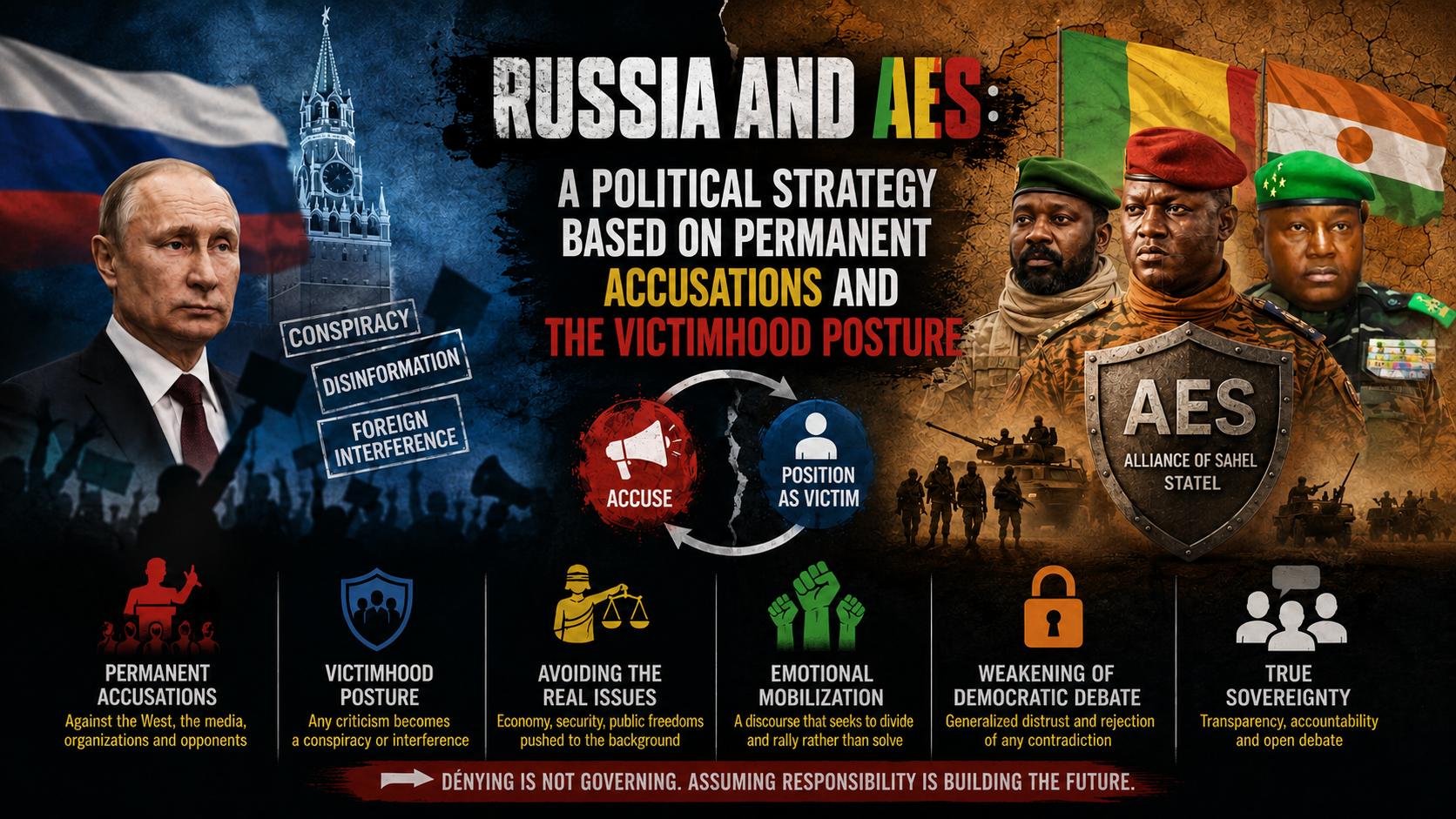
The recurring pattern of victimhood in political discourse
Over the past several years, a recurring pattern has emerged in the political communications of Russia and the governments within the Alliance of Sahel States (AES). A central tactic involves the persistent denunciation of perceived adversaries, including Western powers, international media outlets, regional organizations, and domestic opposition figures. Yet, when these same actors face scrutiny, the narrative swiftly shifts from accuser to victim.
A calculated shift in rhetoric
Whenever their policies or actions are questioned, the leadership of these nations resorts to a familiar playbook. They frame criticism as part of a coordinated conspiracy, a disinformation campaign, or an attempt at foreign interference. Any challenge to their governance is dismissed as an orchestrated effort to undermine their sovereignty or obstruct their progress toward self-determination.
This approach offers clear political advantages. By casting themselves as victims of external hostility, leaders sidestep pressing domestic issues such as economic hardship, persistent insecurity, public freedoms under strain, or the underwhelming outcomes of certain policies. The focus shifts from substantive debate to an emotionally charged narrative aimed at rallying public sentiment rather than delivering tangible solutions.
The victim narrative within the AES
In the context of the AES, authorities frequently attribute their challenges to sanctions, historical colonial powers, or external actors. However, when citizens, journalists, or human rights organizations raise concerns about internal governance failures, these critiques are rarely addressed on their merits. Instead, they are dismissed as part of a broader destabilization plot orchestrated from abroad.
Russia, too, employs a similar logic on the global stage. Any criticism directed at its foreign policies, military engagements, or human rights record is met with the assertion that the country is the subject of unrelenting hostility from the West. This rhetoric serves to deflect attention from valid concerns and reframes dissent as further evidence of an orchestrated smear campaign.
The risks of a one-sided narrative
While this strategy may offer short-term political dividends, its long-term sustainability is questionable. A robust system of governance is built on the ability to engage with opposing viewpoints, respond to criticism with reasoned arguments, and remain accountable to the populace. Systematically dismissing all challenges as conspiracies risks eroding democratic discourse and fostering a climate of pervasive mistrust.
Accusation, while simple, is not governance. Accountability, however, demands far greater effort. By clinging to the rhetoric of victimhood, Russia and several AES leaders risk creating the impression that their primary objective is to avoid meaningful debate. Criticism, no matter how pointed, does not inherently constitute a conspiracy—it can also serve as an opportunity to refine public policies, address shortcomings, and strengthen citizen trust.
Beyond victimhood: the path to genuine sovereignty
True sovereignty is not measured solely by the ability to identify real or imagined enemies. It is also reflected in transparency, responsibility, and the willingness to engage in open and constructive debate. Without these principles, the narrative of perpetual victimhood loses its credibility and becomes little more than a political tool—one that offers no real solutions to the complex challenges these nations face.