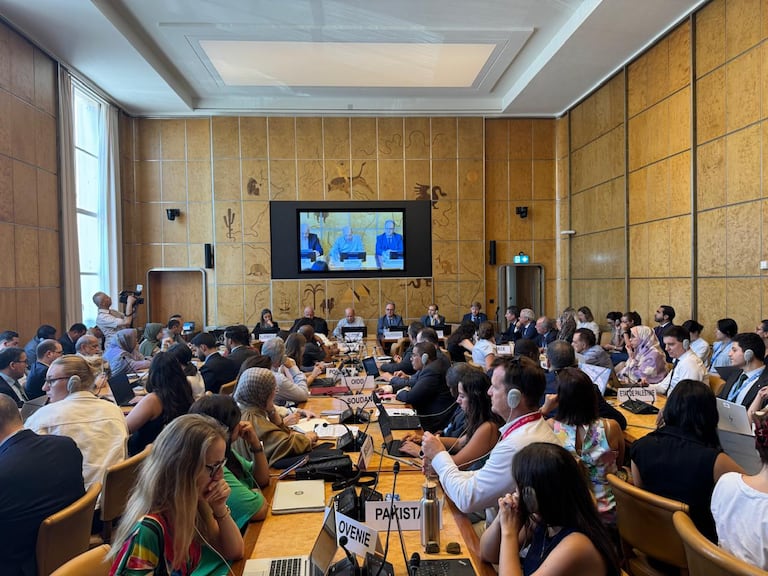
At a pivotal international gathering in Geneva, Morocco underscored the deep connection between corruption and the erosion of fundamental human rights, framing the issue as a critical challenge for global governance. The event unfolded against a backdrop of growing recognition within the United Nations Human Rights Council, particularly following the adoption of resolution 59/6 in July 2025, which explicitly links anti-corruption efforts to the protection of human rights. International frameworks such as the United Nations Convention against Corruption, the Marrakech Declaration of 2011, and the UNGASS 2021 political declaration all emphasize the need for preventive strategies rooted in the rule of law, democratic governance, and human dignity.
Morocco’s delegation, led by Ambassador Omar Zniber, Permanent Representative to the United Nations in Geneva, positioned the country as a proactive leader in this global conversation. Zniber described the initiative as “a landmark step in multilateral diplomacy”, highlighting the coordinated efforts of Moroccan institutions and their alignment with national strategies focused on transparency and ethical governance. The ambassador emphasized the Kingdom’s role in fostering collaboration between domestic agencies and international commitments, positioning Morocco as a model for integrated anti-corruption policies.
corruption’s daily toll on human dignity
El Habib Belkouch, Morocco’s Interministerial Delegate for Human Rights, shifted the discussion from abstract governance concerns to the tangible consequences of corruption. Speaking from a human-centered perspective, he warned that corruption “is not merely a financial crime—it is a systemic violation of human rights.” By diverting resources from essential services, it directly undermines access to justice, healthcare, education, and employment, depriving individuals of rights they are legally entitled to. “Every dirham stolen or wasted through corruption is one less dirham for a school, a clinic, or a public service,” he stated, illustrating how systemic graft disproportionately harms the most vulnerable populations, including women and marginalized communities.
Belkouch argued that prevention must take precedence over punitive measures, identifying transparency, access to information, civic participation, and accountability as fundamental tools in the fight against corruption. These principles, he asserted, are not only rights in themselves but also the bedrock of effective prevention strategies. He further called for stronger institutional synergies, describing coordinated governance as “a cornerstone for enhancing the impact of public policies.”
from financial crime to structural injustice
Mohamed Benalilou, President of Morocco’s National Authority for Integrity, Prevention, and Anti-Corruption, expanded the debate by framing corruption as a structural injustice with far-reaching consequences. He argued that the relationship between corruption and human rights is evolving into a “structurally interdependent system,” where one cannot be addressed without considering the other. This shift demands a rethinking of traditional paradigms, as corruption no longer merely involves embezzled funds—it creates real victims stripped of their rights and dignity.
Benalilou also drew attention to gendered dimensions of corruption, describing it as “an intrinsic barrier to equality.” He called for a broader understanding of its impacts, particularly on women and girls, whose access to resources, education, and justice is often compromised by systemic graft. Furthermore, he introduced a conceptual turning point, asserting that “anti-corruption prevention is evolving into a positive obligation for states to safeguard rights and freedoms.” In this view, preventing corruption becomes a proactive duty of human rights diligence, requiring institutions to do more than simply avoid corruption—they must actively protect rights and guarantee equity.
Among his recommendations, Benalilou emphasized the need to “safeguard civic space” and “recognize whistleblowers as human rights defenders.” He advocated for a shift toward institutional integrity, where governance is not just about absence of corruption but about actively upholding human rights and ensuring fairness across society.
On the international stage, he urged greater coherence between processes in Geneva, Vienna, and New York, stressing that the obligations outlined in the United Nations Convention against Corruption and human rights frameworks are “two sides of the same commitment.” He called for the creation of structural bridges between institutions and the adoption of a rights-based preventive governance model, one that prioritizes human dignity in all anti-corruption efforts.
a call for unified action
As the discussions progressed, a consensus emerged among participants on the urgent need to strengthen collaboration between states, international bodies, and civil society. The focus turned to practical solutions: education, capacity-building, civic engagement, and digital innovation were highlighted as indispensable tools for promoting good governance, enhancing transparency, and preventing abuse. The overarching message was clear—corruption is not just a financial or administrative issue; it is a human rights crisis that demands a unified, rights-centered response.