Gabon: why the fight against high living costs won’t succeed in supermarkets
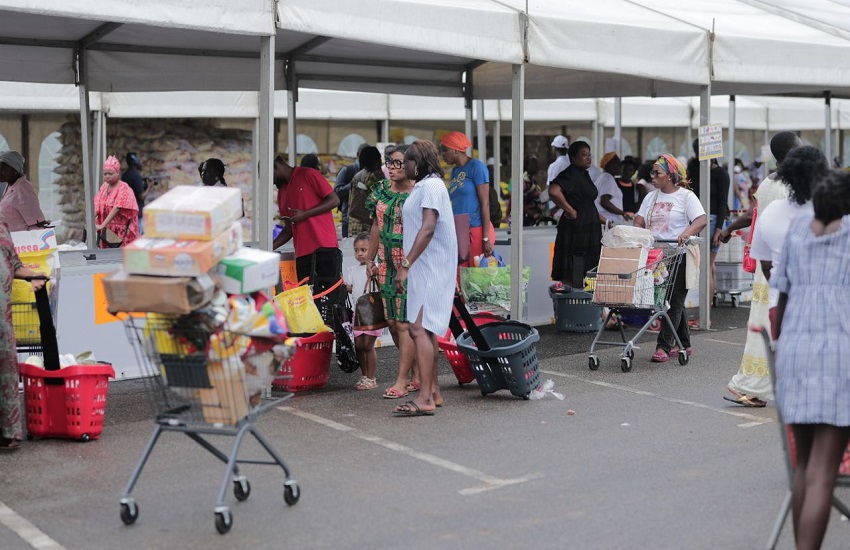
Libreville — The battle against soaring living costs has dominated public discourse in Gabon for years, with rising prices eroding household purchasing power and sparking widespread frustration.
Successive governments have rolled out a range of measures—price controls, tax exemptions, subsidies, flash sales, and even massive government-run markets like those organized by the Gabonese Purchasing Authority (CEAG). While these steps aim to ease financial strain, one critical question lingers: why do prices remain stubbornly high despite these interventions?
Perhaps the answer lies not in the price tags themselves but in deeper economic realities. Could the persistent rise in living costs be less about pricing and more about insufficient wealth creation?
When price cuts hit their limits
Short-term price adjustments provide much-needed relief for vulnerable households. Initiatives like CEAG’s discounted markets temporarily ease pressure by offering essential goods at reduced rates. Yet these measures are, by nature, temporary solutions. Once the campaigns end, consumers return to conventional retail channels, and prices rebound because the underlying factors driving costs remain unchanged.
This doesn’t mean such programs are ineffective—they address symptoms rather than root causes. The real challenge is understanding why prices stay structurally high and why administrative fixes fail to deliver lasting change.
The hidden costs of an import-dependent economy
Public debates often focus on the retail stage, but the problem starts long before goods reach supermarket shelves. Gabon’s heavy reliance on imports—whether food, fuel, or manufactured goods—exposes it to global market fluctuations, shipping costs, and supply chain disruptions. Every price surge abroad inevitably trickles down to local consumers, making inflation an imported phenomenon.
This dependency reveals a harsh truth: a country that imports most of its food imports inflation alongside it. Similarly, exporting raw materials without local processing means exporting potential jobs, income, and future purchasing power. From this perspective, the fight against high living costs transcends mere pricing—it becomes a question of economic model.
From raw materials to added value: the path to affordability
Gabon possesses immense potential: vast forests, rich mineral deposits, fertile agricultural land, a strategic coastal position, and relative political stability. Yet much of this wealth leaves the country in its raw state, only to return as finished products at a premium.
Local processing offers a direct route to lowering living costs. Every factory established generates jobs. Every job creates income. Every income strengthens purchasing power. And stronger purchasing power fuels local consumption, driving further economic growth. The same principle applies to agriculture and livestock.
Boosting local food production, modernizing staple crop supply chains, expanding poultry farming, and supporting agro-industrial initiatives can reduce reliance on food imports. Beyond cutting costs, these sectors create sustainable employment—critical for long-term economic resilience.
The future of Gabon’s fight against high living costs may depend less on price controls and more on transforming its agricultural and industrial base.
Building a resilient middle class
For decades, policymakers have focused on controlling prices. Perhaps it’s time to shift the conversation toward income generation. A nation doesn’t thrive simply because prices are artificially suppressed. It thrives when citizens earn enough to afford essentials, invest in education, plan for the future, and participate fully in the economy.
Expanding the middle class is one of Gabon’s most strategic goals. A dynamic middle class drives domestic demand, attracts private investment, and fosters homegrown entrepreneurship. It also stabilizes society by reducing inequality and improving social cohesion.
The real battle against high living costs may lie in creating productive jobs and sustainable incomes. In this new framework, purchasing power is no longer a byproduct of growth—it becomes a driver of it.
Transparent data as a game-changer
This transformation requires modernizing economic governance. Digital tools for real-time price monitoring could revolutionize how the government tracks inflation, identifies price anomalies, and evaluates policy impact across the country. Accurate, transparent data would shift the debate from perception to evidence, rebuilding trust among consumers, businesses, and public authorities.
In a region where citizens increasingly demand accountability, such reforms could redefine the social contract between the state and its people.
The fight against high living costs in Gabon mirrors challenges faced across Africa. Governments everywhere grapple with the same dilemma: how to protect livelihoods without trapping their economies in a cycle of subsidies and price corrections. Gabon now has a chance to pioneer a different approach—one that combines social support with long-term economic transformation.
By sustaining social protection while accelerating local processing, agricultural development, industrialization, job creation, and digital market transparency, the country can shift the struggle against high living costs from crisis management to sustainable progress.
The question is no longer how long the state can keep lowering certain prices. It’s how many Gabonese will one day live with dignity, supported by stable incomes from a value-creating economy—no longer dependent on temporary fixes to preserve their purchasing power.
That’s the line between an economy that manages symptoms and one that cures the disease. And it may be where the lasting solution to high living costs finally lies.

Thérèse Nguimfack
Journalist