The 2024 presidential election in Senegal marked a turning point with the victory of Bassirou Diomaye Faye, yet the true durability of this democratic momentum hinges on the country’s ability to institutionalize citizen power. Two years after the historic alternance, the absence of direct citizen access to the Constitutional Court—despite recommendations from the 2024 and 2025 national dialogues—reveals a critical gap in Senegal’s democratic architecture. This article explores how citizen power can be sustained beyond electoral moments, drawing on a unique blend of Western political philosophy, Senegalese legal frameworks, and pre-colonial civic traditions.
the evolving concept of citizen power in Senegal
Citizen power in Senegal today cannot be reduced to mere electoral participation or protest. It must be understood as a dynamic interplay between institutional mechanisms and cultural values that have shaped Senegalese society for centuries. The post-2024 period offers a rare opportunity to rethink this concept, not as a Western import but as a synthesis of universal democratic principles and local civic traditions.
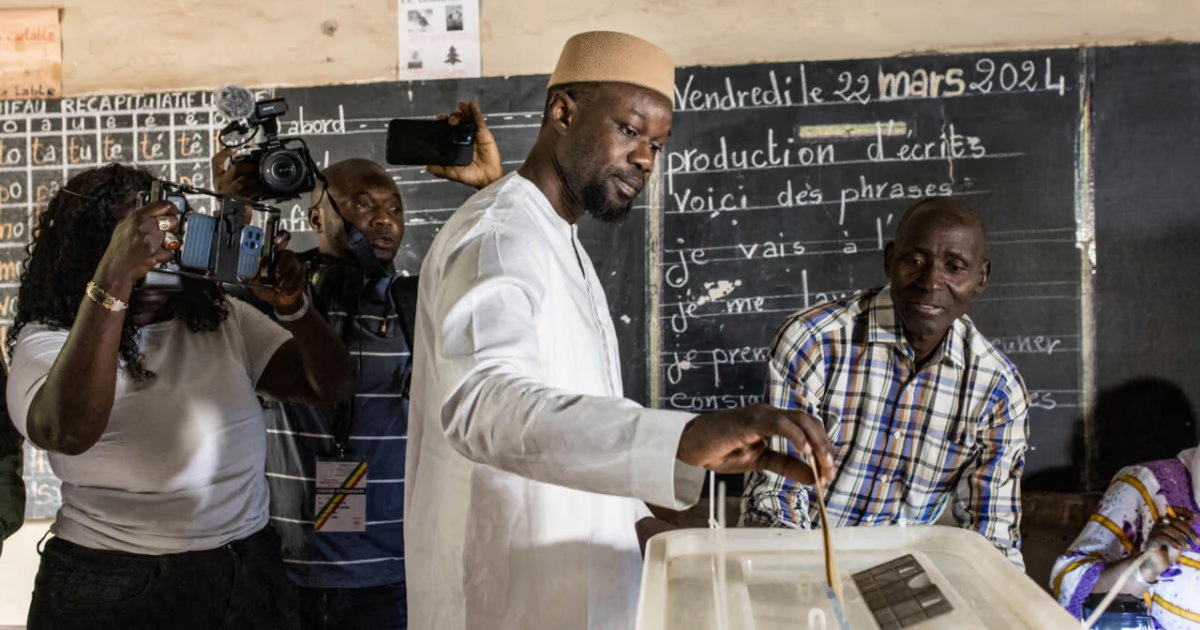
The 2024 election victory, achieved through mass mobilization and legal battles, demonstrated the strength of Senegalese civic engagement. Yet the institutionalization of this power remains incomplete. The failure to implement direct citizen access to constitutional justice—recommended in the 2024 National Dialogue—signals a missed opportunity to consolidate democratic gains. This article argues that true citizen power requires more than periodic elections; it demands robust institutional channels through which citizens can directly challenge violations of their constitutional rights.
historical foundations: from ancient democracy to Senegalese civic culture
The concept of citizenship has evolved through distinct historical phases, each leaving its imprint on Senegal’s political imagination. Western traditions—from Athenian democracy to modern liberal citizenship—emphasize rights, representation, and legal protections. Yet Senegal’s civic identity also draws from pre-colonial traditions like the penc (village assemblies), where decisions emerged through consensus rather than majority rule, and from Wolof ethical values such as jom (honor), kersa (dignity), and teranga (hospitality).
These traditions offer more than nostalgic references; they provide living resources for democratic innovation. The penc model, for instance, prioritizes inclusive deliberation over adversarial debate—a principle that could revitalize local governance in Senegal’s municipalities. Similarly, Wolof virtues like masla (tact) and ngor (integrity) offer ethical frameworks for political conduct that modern institutions alone cannot provide.
Contemporary thinkers like Pierre Rosanvallon and Cynthia Fleury have shown how democratic societies balance trust and vigilance. Rosanvallon’s “counter-democracy” identifies three citizen roles—vigilance, veto, and judgment—that operate alongside formal institutions. Fleury’s work on individuation and resilience highlights the psychological dimensions of citizenship, reminding us that democratic resilience depends not just on laws but on citizens’ capacity to engage courageously with power.
the paradox of Senegalese democracy
Senegal’s democratic journey since independence has been marked by both progress and contradictions. The 2001 Constitution guarantees fundamental rights and establishes a Constitutional Council that has occasionally defended democratic norms, as seen in its 2024 decision annulling the presidential election postponement. Yet critical gaps persist. Article 74 of the Constitution restricts constitutional challenges to political authorities, leaving ordinary citizens without direct recourse. The 2024 and 2025 national dialogues proposed reforms, including citizen access to constitutional justice, but these recommendations have not yet been translated into law.
This paradox reflects a deeper tension in Senegalese democracy: between the promise of popular sovereignty and the reality of institutional exclusions. The 2024 alternance demonstrated the power of mass mobilization, but without institutional channels to sustain citizen vigilance, this energy risks dissipating into perpetual protest—a pattern that could erode democratic legitimacy over time.
civic virtues and institutional renewal
Senegal’s civic renewal requires more than legal reforms; it demands a re-engagement with the ethical foundations of citizenship. Wolof virtues like jom (courage) and kersa (dignity) are not relics of the past but living principles that can guide political behavior today. Similarly, the penc tradition of deliberative consensus offers a model for local governance that complements modern institutions.
Seven key proposals emerge from this analysis:
- direct citizen access to constitutional justice: Citizens should be able to petition the Constitutional Council directly when their constitutional rights are violated, without relying on political intermediaries.
- legal recognition of traditional deliberative spaces: Village assemblies (penc), neighborhood councils (gokh), and youth associations (mbootaay) should be formally recognized as consultation bodies for local decisions.
- civic education rooted in ethical traditions: Senegalese schools should integrate Wolof civic virtues into civic education curricula, combining universal democratic theory with local ethical frameworks.
- strengthening oversight institutions: Bodies like the Court of Auditors and the National Anti-Corruption Office (OFNAC) should gain constitutional independence and allow direct citizen complaints.
- institutionalizing national dialogues: Future dialogues should adopt transparent procedures, including citizen participation quotas and mandatory explanations for rejected recommendations.
- democratic care policies: Addressing youth unemployment and social inequalities through policies that also recognize historical injustices and promote national reconciliation.
- revitalizing decentralization: Municipal budgets should include participatory components, and local authorities should hold annual public accountability sessions.
lessons from comparative experiences
Senegal is not alone in grappling with these challenges. South Africa’s post-apartheid Constitution allows direct citizen petitions to its Constitutional Court, while Tunisia’s 2014 Constitution emerged from an inclusive national dialogue. Both cases demonstrate the importance of institutionalizing citizen power beyond electoral moments. Conversely, Benin’s democratic erosion after its 1990 National Conference and Tunisia’s recent democratic reversal underscore the fragility of such gains without sustained civic vigilance.
These comparative lessons suggest that Senegal’s path forward must be uniquely its own—drawing on both modern institutional frameworks and the rich civic traditions that have sustained Senegalese society for generations.
conclusion: toward a resilient citizen power
Citizen power in Senegal today stands at a crossroads. The 2024 alternance has opened a window for democratic renewal, but its success depends on whether Senegal can institutionalize the civic energy that brought it to power. This requires more than legal reforms; it demands a recommitment to the ethical and deliberative traditions that have long defined Senegalese civic life.
True citizen power emerges when institutions are robust enough to channel civic energy, and when citizens are courageous enough to hold those institutions accountable. The synthesis of modern democratic principles and Senegalese civic traditions offers a path forward—one where democracy is not just a system of laws but a lived practice of dignity, honor, and collective responsibility.