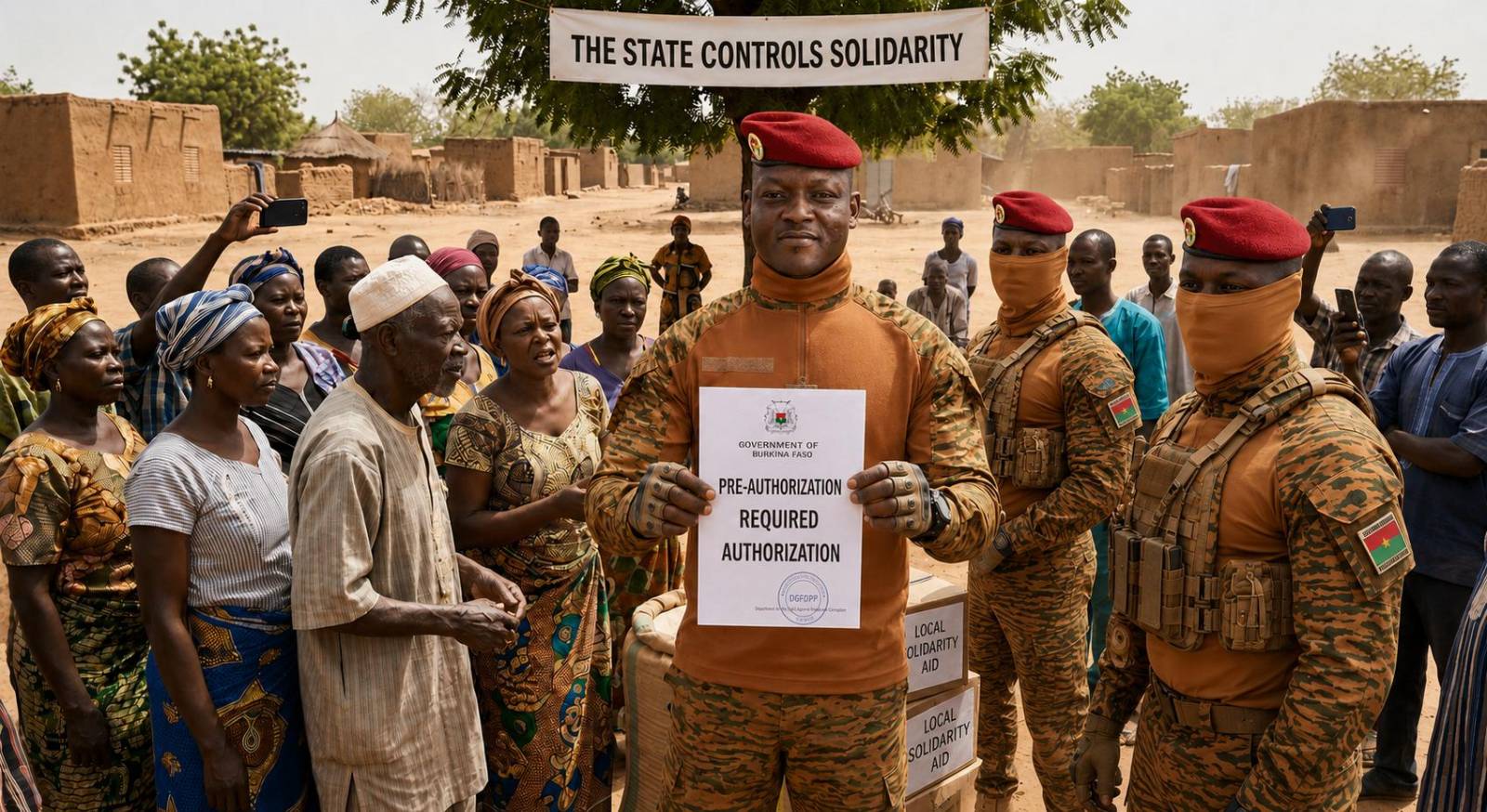
The era of unregulated charity appeals on social media platforms has come to an end in Burkina Faso. The Ministry of Solidarity and National Cohesion has introduced stringent measures requiring prior authorization for all humanitarian actions, with non-compliance subject to penalties. While authorities cite the preservation of human dignity and the prevention of digital exploitation as justification, the measure raises profound questions about individual freedoms and the state’s expanding role in personal altruism.
From spontaneous generosity to state-controlled benevolence
At first glance, regulating charitable practices may appear justified, particularly in an era where social media often reduces human suffering to mere content for public consumption. However, the shift from targeted oversight of abuses to blanket regulation of all citizen-led initiatives crosses a critical threshold. By mandating administrative approval for acts of solidarity, the government risks transforming every charitable gesture into a potential offense, thereby stifling the very spirit of civic engagement it claims to protect.
The requirement for state authorization to extend a helping hand represents a troubling precedent. When the impulse to assist one’s fellow citizen becomes contingent upon bureaucratic approval, it signals a dangerous erosion of personal liberties in a nation where governance appears increasingly suspicious of independent civic action.
The paradox of state monopolization over compassion
This policy underscores a broader bureaucratic tendency to view autonomous civic organizations—whether grassroots associations, religious groups, or diaspora networks—as potential threats rather than partners in addressing societal challenges. Historically, Burkina Faso’s most resilient communities have relied on these networks to respond swiftly to crises, often filling gaps left by delayed or inadequate state interventions. Imposing centralized control over such initiatives not only delays critical aid but also risks undermining the very structures that have sustained communities through years of instability.
The current administration’s approach reveals a fundamental misunderstanding of how social solidarity functions. Compassion cannot be bureaucratized without consequence. When the state positions itself as the sole arbiter of kindness, it does not merely regulate generosity—it appropriates it, transforming a universal human instinct into a state-sanctioned transaction.
A policy disconnected from ground realities
The human cost of this decree is already becoming apparent. In a country grappling with persistent security threats, mass displacements, and deepening economic precarity, the need for rapid, flexible humanitarian responses has never been greater. Yet, by criminalizing spontaneous aid, the government effectively creates a void that its own overburdened administrative systems are ill-equipped to fill. Families in urgent need of support—whether for medical emergencies, shelter, or food—are left stranded as authorization requests languish in ministerial offices.
This disconnect between policy and reality is particularly stark in rural areas, where the