Kaliningrad’s isolation grows as NATO tightens its grip
Once a formidable military bastion for Moscow at the heart of Europe, the Russian territory of Kaliningrad now faces an unprecedented tightening of controls by its NATO neighbors. Between logistical restrictions and heightened border security, the exclave is increasingly cut off from the outside world.
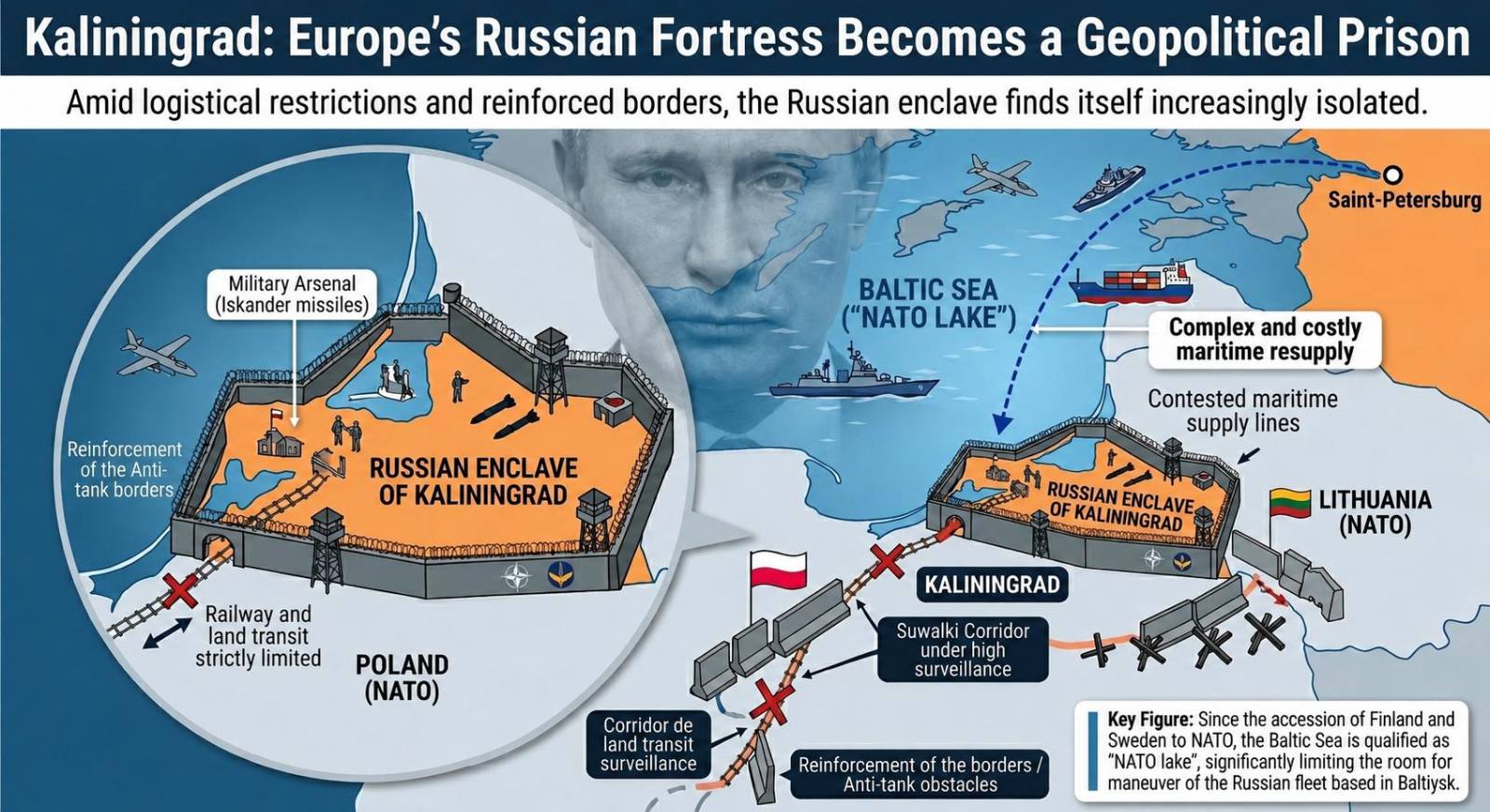
This development marks a major strategic shift along the eastern fringes of the European Union. Sandwiched between Poland and Lithuania, the heavily militarized Kaliningrad region—long seen by the Kremlin as a power-projection hub, particularly with its Iskander missile systems—has become a besieged fortress, detached from global supply lines.
Under the leadership of Warsaw, Vilnius, and Riga, NATO has systematically intensified pressure on the exclave, turning its geographic vulnerability into a potent deterrent lever against Russian aggression.
the suffocating grip on transit routes
The estrangement is not abrupt but the culmination of a deliberate, gradual squeeze. Poland and the Baltic states have progressively tightened transit conditions for goods and personnel bound for Kaliningrad:
- railway bottlenecks: the Suwałki corridor, a narrow land bridge linking Belarus to Kaliningrad, now faces heightened scrutiny. Rail freight, still reliant on Soviet-era infrastructure, has been slashed to the bare minimum permitted under European sanctions.
- energy chokeholds: overland fuel and energy shipments have plummeted, forcing Moscow to resort to costly maritime resupply via the Baltic Sea to prevent operational paralysis.
- fortified borders: physical barriers now dominate the landscape. Poland and Lithuania have erected anti-tank ditches, barbed-wire fences, and surveillance systems, effectively sealing off access to the Russian exclave.
A critical development: with Finland and Sweden’s accession to NATO, the Baltic Sea has become a de facto NATO lake, severely constraining the operational space of Russia’s Baltic Fleet based in Baltiysk.
a logistical trap for the kremlin
For Vladimir Putin, the predicament in Kaliningrad presents a first-order strategic dilemma. While the exclave remains heavily armed, its ability to withstand a prolonged conflict is increasingly questioned by military analysts. Deprived of seamless overland links to mainland Russia, its forces are now entirely dependent on maritime and aerial supply lines—routes that are growing more contested by the day.
Some observers argue that what Moscow once viewed as its sharpest sword against the West has turned into a liability: in the event of open hostilities, the territory could find itself immediately encircled and isolated by a unified and vigilant NATO.
diplomatic deadlock looms
In response to the de facto blockade, Moscow has repeatedly condemned the curtailment of transit rights as a breach of international treaties, threatening retaliatory measures. Yet Poland and the Baltic states, backed by their Western allies, defend the restrictions as essential to national security amid Russia’s aggressive actions in Ukraine.
The question now is how far this logistical war of attrition can escalate before igniting a military spark in one of the world’s most heavily militarized regions.