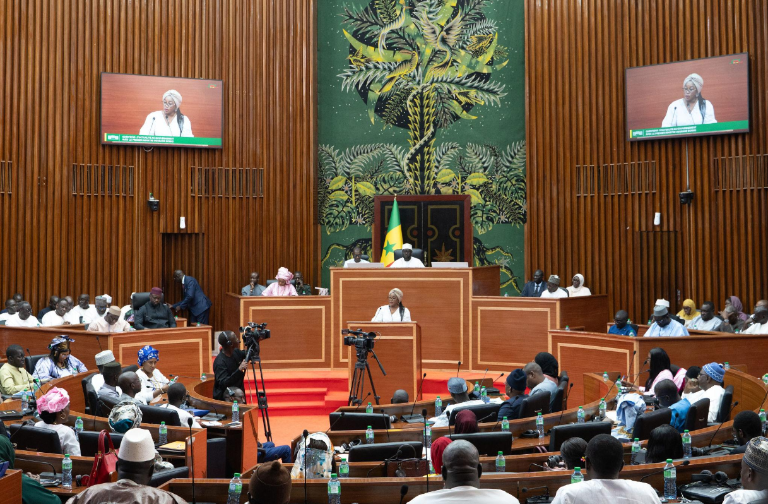
The Cameroonian Parliament is set to convene its second ordinary session of the year on June 9, with the budget debate taking center stage. Lawmakers will assess the broad strokes of the 2027 budget proposal against a backdrop of financial strain, compounded by dwindling public revenue and political uncertainty. This year’s session is particularly critical, arriving at a time when the government struggles to meet the goals set in the 2026 finance law, which was allocated 8,800 billion CFA francs.
Budget debate under tight liquidity constraints
In Cameroon’s parliamentary process, the budget orientation debate serves as a pivotal moment where the government outlines its macroeconomic priorities for the coming year. This year, however, the stakes are higher than usual. Fiscal mobilization has fallen short of projections, while debt servicing continues to strain the national budget, leaving little room for maneuver.
The 2026 budget, initially set at 8,800 billion CFA francs (approximately 13.4 billion euros), now appears increasingly difficult to achieve. As in previous years, authorities are expected to introduce a supplementary finance bill to recalibrate spending and formalize the gap between anticipated and actual revenue collected in the first half of the year. This adjustment will likely involve scaling back certain expenditure lines to realign with fiscal reality.
Political limbo amplifies budgetary challenges
The economic difficulties are further complicated by a lingering political uncertainty. For nearly six months, rumors of a government reshuffle have circulated in Yaoundé without materializing. This prolonged uncertainty has fostered hesitation within the administration, delaying crucial decision-making in key spending ministries. Businesses and investors, too, are holding back on major commitments, awaiting clarity on who will lead the ministries that directly impact economic policy.
This paralysis has tangible consequences. Infrastructure projects, often financed through external funding, are experiencing disbursement delays due to sluggish domestic counterpart funding. For international partners, this raises concerns about Cameroon’s ability to sustain reforms tied to its International Monetary Fund (IMF) program.
Regional economic ripple effects
As the largest economy in the Central African Economic and Monetary Community (CEMAC), Cameroon’s fiscal health is intrinsically linked to the stability of the subregion. Any deviation in its public finances has a direct impact on the region’s pooled foreign reserves, managed by the Bank of Central African States (BEAC). With Cameroon contributing nearly 40% of the CEMAC’s GDP, its budget choices resonate far beyond its borders.
Lawmakers must also navigate an unpredictable global environment. Oil prices, a major revenue driver for the state, remain volatile. Meanwhile, the country’s hydrocarbon output is in structural decline, intensifying the urgency of broadening the tax base. The budget debate could reignite discussions on modernizing tax administration and expanding the taxable base—long-standing initiatives that have yet to yield concrete results.
Yet, the looming electoral calendar casts a shadow over the proceedings. Some legislators question whether it is practical to establish a robust three-year fiscal framework when the government’s composition remains in flux. Within the halls of the National Assembly, the session is already viewed as a transitional exercise—one more focused on short-term adjustments than on laying down a long-term structural path. Without full alignment between ambition and execution, the government approaches this parliamentary milestone with limited capacity to deliver on its original objectives.