Benin’s economic resilience positions it for eco adoption by 2027
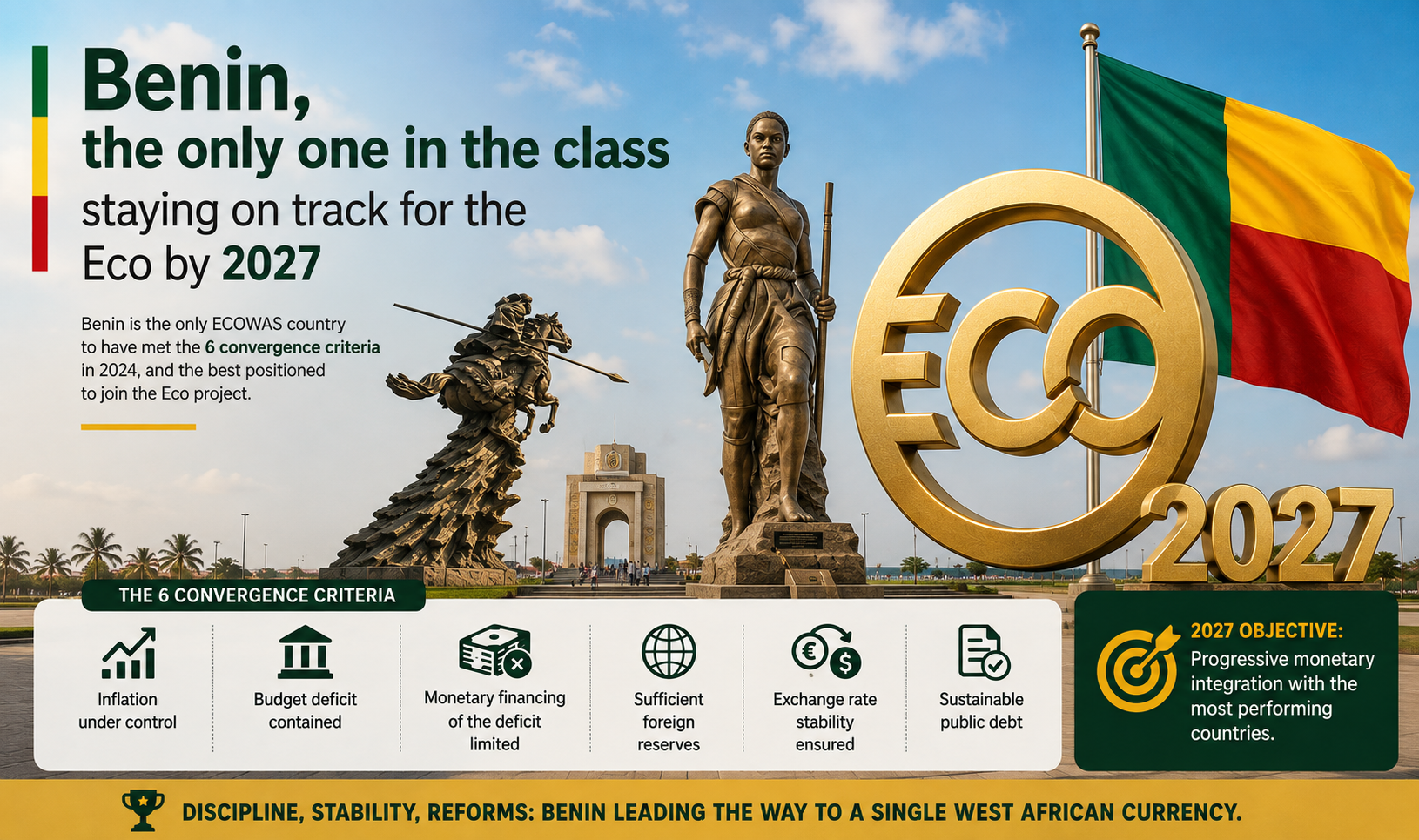
The Economic Community of West African States (CEDEAO) remains committed to launching the Eco by 2027, yet the region’s economic disparities suggest not all member states will progress at the same pace. In this landscape, Bénin stands out as one of the most prepared countries to participate in an initial phase of monetary integration.
Economic integration ambitions face regional challenges
The concept of a single West African currency has long been a cornerstone of CEDEAO’s economic integration efforts. However, translating political ambition into economic reality presents formidable challenges: volatile inflation, unsustainable public deficits, rising debt levels, depleting foreign reserves, monetary instability, and stark economic disparities among member states.
Against this backdrop, the 2027 target may necessitate a staggered approach, where countries meeting convergence criteria could adopt the Eco first, while others continue working toward alignment.
Bénin meets all convergence criteria
In 2024, Bénin distinguished itself as the sole CEDEAO member to satisfy all six macroeconomic convergence criteria required for monetary integration. This achievement extends beyond mere numerical compliance; it reflects a consistent and credible economic policy framework.
The convergence criteria evaluate multiple dimensions of economic stability:
Inflation control: Ensuring price stability and preserving purchasing power.
Budget deficit limits: Adhering to community-established fiscal rules.
Monetary financing restrictions: Preventing excessive money supply growth to fund public spending.
Adequate foreign reserves: Covering several months of import expenditures.
Exchange rate stability: A prerequisite for credible monetary integration.
Sustainable public debt: Maintaining debt at manageable levels.
These benchmarks ensure that participating economies maintain a minimum standard of fiscal discipline, preventing disparities from undermining the union’s stability.
Strategic reforms underpin economic stability
Bénin‘s current performance is the result of years of deliberate economic and fiscal reforms. The government has prioritized revenue mobilization, enhanced public financial management, and sustained high levels of investment in infrastructure and essential services. Balancing budgetary discipline with developmental spending has required careful policy navigation, particularly in a developing economy context.
The critical next step will be maintaining this convergence trajectory. While compliance in a single year signals progress, sustained adherence over multiple years will be essential to bolster the country’s credibility in the Eco initiative.
Progressive integration may reshape regional dynamics
The heterogeneity of West African economies poses a significant hurdle. Member states grapple with varying levels of debt, inflation, fiscal space, and external pressures compounded by security crises, geopolitical tensions, and regional trade disruptions.
A phased adoption model could offer a pragmatic solution, allowing economies meeting convergence criteria to adopt the Eco ahead of others. Bénin, with its demonstrated stability, is well-positioned to be among the first to transition.
Strategic advantages of early adoption
Should this phased approach materialize, Bénin‘s early participation in the Eco could yield substantial strategic benefits. Beyond the symbolic shift in currency, monetary integration demands closer alignment of fiscal, financial, and economic policies. For Bénin, this could enhance its regional economic influence, attract foreign investment, and strengthen trade integration.
However, the path to 2027 remains uncertain. The feasibility of the Eco’s launch hinges on both economic performance and collective political decisions among CEDEAO member states.
Governance and regional shifts add complexity
Key considerations include the governance structure of the Eco, the role of regional institutions, monetary policy frameworks, and mechanisms for fiscal solidarity. The recent withdrawal of several Sahelian states from the CEDEAO further complicates the integration landscape, requiring a recalibration of the original vision for monetary union.
The challenge of maintaining momentum
While Bénin currently holds a competitive advantage, this position is not guaranteed without sustained effort. Core priorities include preserving macroeconomic stability, managing debt levels, controlling inflation, and continuing structural reforms all while funding critical development projects.
As 2027 approaches, the challenge will not merely be to lead the pack but to remain among the frontrunners when the Eco transitions from policy ambition to economic reality. If implemented progressively, the Eco could position Bénin as a regional leader, having overcome the technical and economic obstacles that have long delayed monetary integration in West Africa.